

Are Peptides Legal in the USA? What You Need to Know

Peptides are classified as drugs under the Federal Food, Drug, and Cosmetic Act, making their legal status in the United States far more regulated than most wellness content suggests. Any peptide intended to affect the structure or function of the human body requires FDA approval before it can be legally marketed or sold as a therapeutic product. Popular compounds like BPC-157, TB-500, and Ipamorelin cannot legally be marketed as therapeutic drugs without that approval. The peptides legal question is not a simple yes or no. It depends entirely on the compound, the source, the intended use, and whether a licensed clinician is involved.
Are peptides legal under FDA rules?
The FDA does not maintain a separate regulatory category for peptides. Every peptide intended to affect body structure or function is treated as a drug under federal law. That single classification drives the entire legal framework around peptide therapy in the United States.

Within that framework, the FDA separates peptides into two practical groups. First, there are FDA-approved peptides. These have completed clinical trials, received formal approval, and can be legally prescribed and dispensed. Semaglutide, the active ingredient in Ozempic and Wegovy, is the most recognized example. GLP-1 receptor agonists as a class represent the clearest model of what legal peptide therapy looks like in practice.
Second, there are unapproved peptides that appear on the FDA’s bulk substance lists for compounding pharmacies. Category 1 substances are those the FDA has evaluated and determined may be compounded legally under 503A rules, meaning a licensed compounding pharmacy can prepare them for individual patients with a valid prescription. Category 2 substances are those the FDA has flagged as presenting safety concerns, and compounding them is prohibited.
- Category 1 peptides: May be legally compounded by 503A pharmacies with a valid prescription from a licensed clinician.
- Category 2 peptides: Banned from compounding due to safety concerns identified by the FDA.
- FDA-approved peptides: Fully legal to prescribe, dispense, and use under standard pharmaceutical rules.
- Unapproved, unlisted peptides: Cannot legally be marketed for human therapeutic use regardless of how they are labeled.
Pro Tip: Before pursuing any peptide therapy, ask your provider specifically whether the compound is on the FDA’s Category 1 list or has full FDA approval. That one question tells you whether your access pathway is legal.
Why buying “research chemical” peptides is risky and illegal
A large portion of the peptides sold online in the United States are marketed under the label “Research Use Only” or RUO. Many buyers assume this label creates a legal loophole. It does not. The FDA applies the Objective Intent Doctrine to determine legality, which means regulators look at how a product is marketed and sold, not just what the label says.
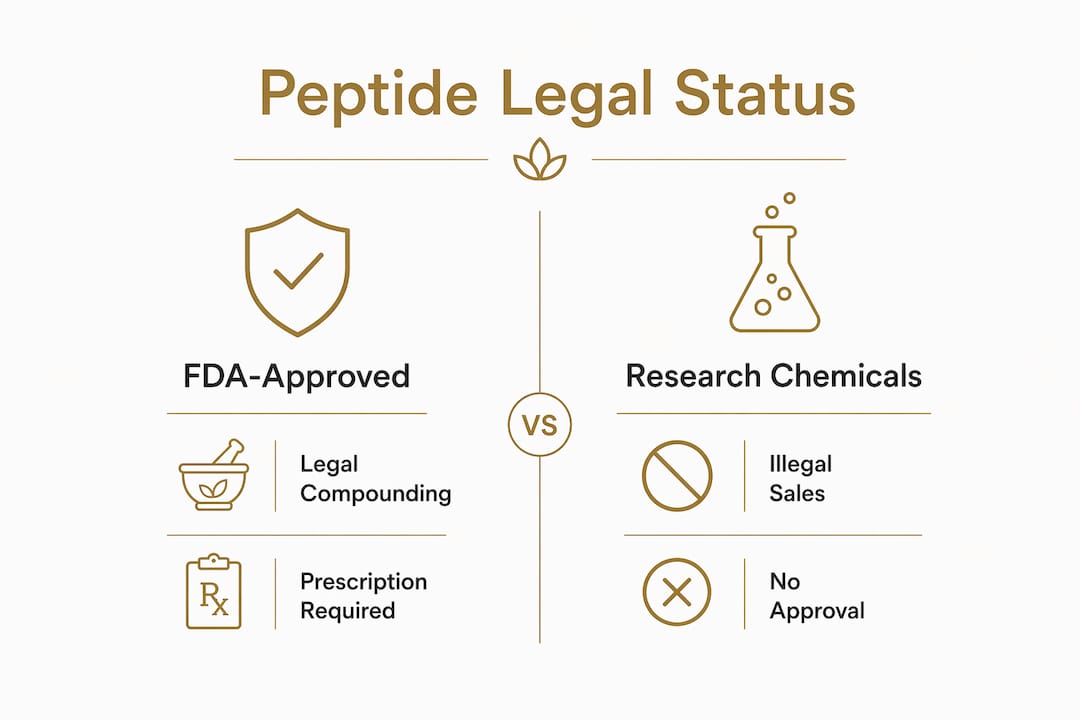
If a seller promotes a peptide for muscle recovery, fat loss, or injury healing while technically labeling it “not for human use,” the FDA treats that product as an unapproved drug marketed for human consumption. The label is irrelevant. The marketing intent governs the legal classification. Consumers who purchase these products and self-administer them are engaging in unapproved drug use, which carries real legal and health consequences.
The health risks compound the legal ones. Grey market peptides operate outside any manufacturing oversight. There are no sterility requirements, no standardized dosing, and no third-party purity testing. Grey market peptides often lack sterility, standardization, and legal protections, meaning what you inject may contain contaminants, incorrect concentrations, or entirely different compounds than advertised.
Here is what the legal exposure actually looks like for buyers and sellers:
- Sellers who market RUO peptides for human wellness applications face FDA enforcement actions, including product seizure, injunctions, and criminal prosecution.
- Buyers who self-administer unapproved peptides are using an illegal drug under federal law, regardless of whether they purchased it legally in their state.
- Medical practitioners risk license sanctions if they administer peptides that lack FDA approval or are dispensed outside 503A compounding pharmacy compliance rules.
- Importers who bring foreign-manufactured peptides into the United States for personal use face customs seizure and potential federal charges.
“Consumers mistakenly assume ‘research chemicals’ labeled peptides are a legal loophole. Intent to self-administer classifies such use as unapproved drug use and is illegal.” — Sourcing & legal status of peptides
What changed with the 2026 FDA reclassification
The most significant recent development in peptide therapy legal status came in February 2026, when HHS Secretary Robert F. Kennedy Jr. announced plans to move 14 peptides from Category 2 back to Category 1. This announcement generated significant attention in wellness and medical communities, but it requires careful interpretation.
The reclassification does not mean those peptides are now FDA-approved drugs. Reclassification enables legal compounding under 503A rules but does not substitute for the formal drug approval process. A compounding pharmacy can legally prepare a Category 1 peptide for a specific patient with a valid prescription. That same pharmacy cannot manufacture it in bulk or market it as a finished drug product.
| Peptide status | Compounding allowed | Prescription required | FDA drug approval |
|---|---|---|---|
| FDA-approved (e.g., semaglutide) | Yes, under specific rules | Yes | Yes |
| Category 1 bulk substance | Yes, via 503A pharmacy | Yes | No |
| Category 2 bulk substance | No | N/A | No |
| Unlisted/unapproved | No | N/A | No |
The FDA advisory panel meetings scheduled for July 2026 will evaluate additional peptides for potential reclassification. These meetings are part of the formal rulemaking process that must follow any policy announcement before compounding pharmacies can legally act on it. Regulatory announcements set policy direction, but published FDA guidance and formal rulemaking are required before practical legal compounding resumes for newly reclassified compounds.
Pro Tip: If a compounding pharmacy claims it can legally prepare a peptide based solely on the February 2026 HHS announcement, ask for documentation of the FDA’s formal rulemaking. An announcement alone does not authorize compounding.
How to legally and safely access peptide therapy in the U.S.
The only legal pathway for peptide therapy in the United States runs through a licensed clinician and an authorized compounding pharmacy operating under 503A rules. That pathway is not complicated, but it requires working with providers who understand and follow FDA regulations.
Here is what a compliant peptide therapy process looks like:
- Licensed clinician consultation: A physician, nurse practitioner, or other licensed prescriber evaluates your health history and determines whether a peptide therapy is appropriate and legally prescribable.
- Valid prescription: The clinician issues a prescription for a specific compound, dose, and duration. No prescription means no legal access to compounded peptides.
- 503A-compliant pharmacy: The prescription goes to a compounding pharmacy registered with the FDA and operating under 503A rules. These pharmacies prepare patient-specific formulations rather than mass-produced batches.
- Third-party purity testing: Legitimate compounders test their preparations for potency, sterility, and purity. Ask your provider whether the pharmacy they use conducts independent third-party testing.
- Ongoing medical supervision: Legal peptide therapy is not a one-time transaction. It involves follow-up appointments, dosage adjustments, and monitoring for adverse effects.
Recognizing red flags matters just as much as knowing the right pathway. Avoid any source that sells peptides without requiring a prescription, ships internationally without customs documentation, markets compounds as “research chemicals” while describing human health benefits, or cannot provide pharmacy accreditation details. Patients should avoid grey market sources due to risk of adulteration and lack of quality control. FDA-registered compounders provide meaningfully safer options.
FDA-approved peptides like semaglutide demonstrate what the gold standard looks like. They have completed clinical trials, carry established dosing protocols, and are dispensed through regulated channels. Reviewing a peptide weight loss protocol from a licensed provider gives you a concrete model for what compliant access looks like in practice.
Key takeaways
The legal status of peptides in the U.S. is determined by FDA drug classification, not by how a product is labeled or where it is sold.
| Point | Details |
|---|---|
| Peptides are drugs under federal law | Any peptide intended to affect body structure or function requires FDA approval to be legally marketed. |
| Grey market RUO peptides are illegal for human use | The Objective Intent Doctrine means marketing context determines legality, not the “research use only” label. |
| 2026 reclassification enables compounding, not approval | Moving peptides to Category 1 allows 503A pharmacy compounding with a prescription, but is not FDA drug approval. |
| Legal access requires a prescription | The only compliant pathway involves a licensed clinician, a valid prescription, and an FDA-registered 503A pharmacy. |
| FDA-approved peptides are the clearest legal option | Compounds like semaglutide have completed trials and can be prescribed and dispensed through standard regulated channels. |
The uncomfortable truth about peptide hype in 2026
I have spent considerable time reviewing how peptide therapy is discussed across social media, wellness forums, and telehealth marketing. The gap between what the science supports and what influencers claim is genuinely alarming.
The February 2026 HHS announcement was real, and the reclassification of 14 peptides back to Category 1 is a meaningful policy shift. But the way that news traveled through wellness communities turned a procedural regulatory update into a declaration that peptides are now freely legal. They are not. Experts warn that widespread unregulated use of unapproved peptides could produce a “tobacco moment” if serious harms emerge after years of unmonitored self-administration. That framing is not alarmist. It is historically accurate.
What I find most concerning is the confidence with which people self-administer compounds that have no robust human clinical trial data. Many peptides lack the human trial evidence needed to establish safe dosing ranges, drug interactions, or long-term effects. Buying a grey market peptide and injecting it based on a Reddit thread is not a wellness practice. It is an uncontrolled experiment with your own body.
The patients I see making the best decisions are the ones who treat regulatory uncertainty as a reason to slow down, not speed up. They wait for formal FDA guidance. They work with clinicians who can actually monitor their response. They use pharmacies that publish their testing results. That approach is slower and less exciting than ordering a vial online, but it is the one that holds up when something goes wrong.
— Amy
Legal peptide therapy, done right at Revive-meds
Revive-meds is a licensed telehealth clinic built specifically for patients who want peptide and GLP-1 therapy done correctly. Every medication is US-compounded at FDA-registered pharmacies, purity tested at 99%+, and reviewed by a clinician before it ships to your door. There are no membership fees and no waiting rooms. You get unlimited provider messaging, HSA/FSA eligibility, and care delivered in 48 to 72 hours. If you are ready to explore legal peptide protocols with a licensed provider who understands the 2026 regulatory environment, Revive-meds is the place to start. You can also explore GLP-1 therapy options for a fully regulated, clinician-supervised approach to metabolic health.
FAQ
Are peptides legal to buy in the United States?
Peptides are legal to buy only when obtained through a licensed clinician with a valid prescription from an FDA-registered 503A compounding pharmacy. Purchasing peptides labeled as “research chemicals” online for personal use violates FDA regulations.
What makes a peptide illegal?
The FDA applies the Objective Intent Doctrine, meaning a peptide becomes illegal when it is marketed for human therapeutic use without FDA approval, regardless of how it is labeled. Sellers who promote RUO peptides for wellness or performance purposes are distributing unapproved drugs under federal law.
Did the 2026 reclassification make peptides legal?
The February 2026 HHS announcement moved 14 peptides from Category 2 back to Category 1, which enables legal compounding under 503A rules once formal FDA rulemaking is complete. It does not constitute FDA drug approval and does not legalize peptides for unregulated purchase or use.
Which peptides are currently FDA-approved?
Semaglutide (Ozempic, Wegovy) and other GLP-1 receptor agonists are among the most widely recognized FDA-approved peptide-based medications. These have completed clinical trials and can be legally prescribed and dispensed through standard pharmacy channels.
Are peptides safe to use without a prescription?
Peptides obtained outside regulated channels carry significant safety risks, including contamination, incorrect dosing, and unknown impurities. Medical supervision is required to monitor for adverse effects, adjust dosing, and verify that the compound is appropriate for your specific health profile.