

FDA Peptides: What’s Approved, What’s Not in 2026

FDA peptides are peptides that have either received full FDA approval for specific medical indications or have been classified under FDA compounding categories that permit limited, physician-supervised use without constituting full drug approval. The distinction matters enormously. Semaglutide and tirzepatide, both FDA-approved GLP-1 agonists, have cleared rigorous clinical trials and carry defined safety profiles. Peptides like BPC-157 and TB-500 exist in a different category entirely. A 2026 FDA reclassification moved 14 previously restricted peptides back to Category 1 compounding status, restoring physician-supervised access. That reclassification is not FDA approval. Understanding the difference is the first step toward using peptide therapies safely and legally.
What does “FDA approved” mean for peptides?
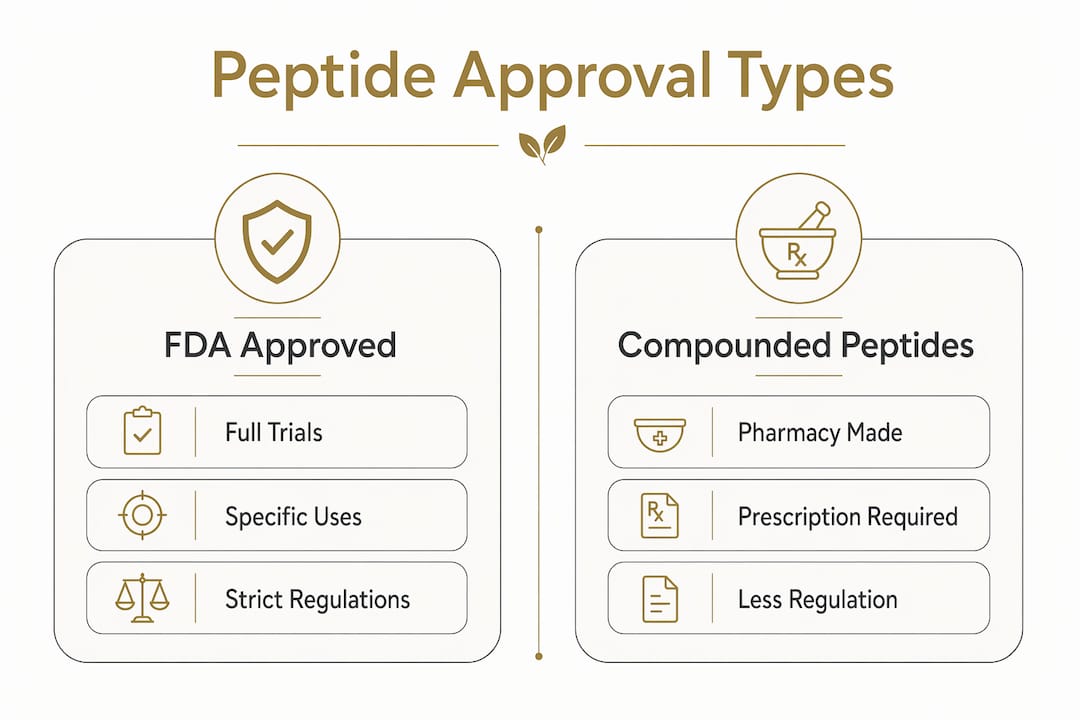
FDA approval and FDA-regulated compounding access are two separate legal pathways, and conflating them is the most common mistake people make when researching peptide therapies.
Full FDA approval requires a drug manufacturer to submit a New Drug Application (NDA) or Biologics License Application (BLA) backed by Phase I, II, and III clinical trials demonstrating safety and effectiveness. The FDA reviews manufacturing standards, labeling, and post-market surveillance plans before granting approval. This process typically takes 10 to 15 years and costs hundreds of millions of dollars. Peptides that clear this bar carry an FDA-approved indication, meaning they can be legally marketed and prescribed for that specific use.

Compounding access works differently. The FDA classifies compounded peptides into two categories. Category 1 peptides meet minimum safety data thresholds and can be legally prepared by licensed compounding pharmacies under a physician’s prescription. Category 2 peptides present safety concerns significant enough that the FDA restricts their compounding. Compounded peptides under Category 1 have not undergone full clinical drug approval. They are allowed for specific, supervised uses because the available safety data supports limited access, not because they have been proven effective through the same standard applied to approved drugs.
Pro Tip: When a clinic or website describes a peptide as “FDA regulated” or “FDA registered,” ask specifically whether the peptide itself holds an FDA-approved indication. Those phrases describe the pharmacy or facility, not the drug.
The practical implication is significant. A peptide available through a compounding pharmacy is legal to prescribe and dispense, but it carries less certainty about efficacy and long-term safety than a fully approved drug. Patients deserve to know which category they are working with before starting any protocol.
Which peptides are FDA approved and what do they treat?
The list of fully FDA-approved peptide drugs is shorter than most wellness content suggests, and each approval is tied to a narrow clinical indication.
| Peptide | FDA-Approved Indication | Approval Year |
|---|---|---|
| Semaglutide (Ozempic, Wegovy) | Type 2 diabetes; chronic weight management | 2017, 2021 |
| Tirzepatide (Mounjaro, Zepbound) | Type 2 diabetes; obesity | 2022, 2023 |
| Tesamorelin (Egrifta) | HIV-associated abdominal lipodystrophy | 2010 |
| Leuprolide (Lupron) | Prostate cancer; endometriosis; precocious puberty | 1985 |
| Oxytocin (Pitocin) | Labor induction; postpartum hemorrhage | Long-standing |
GLP-1 receptor agonists represent the most clinically consequential FDA-approved peptide medicines developed in recent decades. Semaglutide and tirzepatide transformed metabolic disease management by producing sustained weight loss and glycemic control in large-scale trials, making them the benchmark for what rigorous peptide approval looks like.
Tesamorelin’s approval tells a different story. Tesamorelin is FDA-approved exclusively for reducing excess abdominal fat in HIV patients with lipodystrophy, a condition caused by antiretroviral therapy. That approval, granted under NDA 022505 in 2010, does not extend to general anti-aging use, body recomposition, or growth hormone optimization in healthy adults. Clinics marketing tesamorelin for those purposes are operating outside the approved indication.
Leuprolide, a synthetic GnRH analog, demonstrates how peptide approvals can span multiple indications over decades. Its use in prostate cancer, endometriosis, and central precocious puberty reflects the depth of clinical evidence required for each separate indication. Reproductive hormone peptides like gonadorelin and buserelin follow similar approval structures, each tied to specific fertility or oncology applications.
Pro Tip: Search the FDA’s Drugs@FDA database directly using a peptide’s generic name to confirm its approved indication before starting any protocol. Marketing language rarely matches the actual label.
Broad anti-aging or performance enhancement claims for FDA-approved peptides almost universally lack FDA validation. Approved peptides are approved for what the clinical trials tested, nothing more.
What is the 2026 FDA peptide reclassification?
The 2026 reclassification is the most significant regulatory shift in the peptide space in years, and it is widely misunderstood.
In 2023, the FDA moved a group of peptides from Category 1 to Category 2 compounding status, effectively restricting their availability through licensed pharmacies. The agency cited insufficient safety data and concerns about unregulated use. That decision cut off access to peptides that many physicians had been prescribing for years, creating significant friction in functional medicine and sports medicine practices.
In 2026, HHS Secretary RFK Jr. directed the FDA to reconsider those restrictions. The result was a reclassification of 14 peptides back to Category 1 status, restoring compounding pharmacy access under physician oversight. Five peptides remained in Category 2 due to ongoing safety concerns. The reclassified peptides include:
- BPC-157: Studied for gastrointestinal repair and tissue healing; listed for ulcerative colitis but widely marketed online for athletic injury recovery
- TB-500 (Thymosin Beta-4): Investigated for wound healing and inflammation reduction
- Thymosin Alpha-1: Used in immune modulation research
- MOTS-C: Studied for metabolic regulation and mitochondrial function
- Semax: Researched for neuroprotection and cognitive support
- Selank: Investigated for anxiolytic effects
- Epitalon: Studied in longevity research contexts
- GHK-Cu: Researched for skin repair and anti-inflammatory effects
- AOD-9604: Investigated as a growth hormone fragment for fat metabolism
The political influence on this reclassification is worth acknowledging directly. Regulatory decisions shaped by advocacy pressure rather than completed clinical trials introduce uncertainty. Reclassification to Category 1 means these peptides meet a minimum safety threshold for compounding. It does not mean the FDA has reviewed and validated their efficacy for the uses most commonly marketed online.
Patients and prescribers working with these peptides should treat them as investigational compounds with promising but incomplete evidence, not as proven therapies.
How can you safely access and use peptide therapies?
Legal, safe access to both FDA-approved and compounded peptides follows a clear process. Cutting corners at any step increases risk significantly.
- Get a prescription from a licensed physician. No legitimate compounding pharmacy will dispense a Category 1 peptide without one. Any source offering peptides without a prescription is operating outside FDA rules, regardless of how the product is labeled.
- Use an FDA-registered compounding pharmacy. Compounded peptides must be prepared by licensed pharmacies following strict sterility and purity standards. Ask your prescriber which pharmacy they use and verify its registration status through the FDA’s database.
- Confirm purity testing. Reputable compounding pharmacies provide certificates of analysis showing purity levels. Revive-meds, for example, requires 99%+ purity testing on all compounded medications before they ship.
- Avoid gray market sources. Online peptide markets include a significant gray zone where products are sold as “research chemicals” with no quality controls, no dosing guidance, and no physician oversight. These products pose real contamination and dosing risks.
- Establish monitoring with your prescriber. Peptide therapies, even those with strong safety profiles, require baseline labs and follow-up monitoring. Dosing protocols vary by individual, and clinical supervision catches problems early.
Pro Tip: HSA and FSA accounts can often be used for physician-prescribed peptide therapies obtained through licensed telehealth clinics. Check with your plan administrator before assuming they are ineligible.
The gray market problem is not trivial. Peptides sold without prescription oversight lack standardized dosing, sterility assurance, or adverse event reporting. The FDA’s safety skepticism toward unregulated peptide sources reflects real contamination incidents, not bureaucratic overcaution.
Key takeaways
FDA-approved peptides like semaglutide and tirzepatide have cleared full clinical trial review, while compounded peptides like BPC-157 and Semax operate under physician-supervised access rules that are not equivalent to FDA approval.
| Point | Details |
|---|---|
| Approval vs. compounding | Full FDA approval requires clinical trials; Category 1 compounding requires only minimum safety data. |
| Top approved peptides | Semaglutide, tirzepatide, and tesamorelin each carry narrow, specific FDA-approved indications. |
| 2026 reclassification | 14 peptides moved back to Category 1, restoring access but not granting FDA approval. |
| Safe access requirements | A prescription and an FDA-registered compounding pharmacy are non-negotiable for legal use. |
| Anti-aging claims | Broad performance and anti-aging claims for most peptides lack FDA-validated evidence. |
Why the approval distinction matters more than most people realize
I have spent years watching the peptide conversation swing between two extremes. One side dismisses every non-approved peptide as dangerous quackery. The other treats a compounding pharmacy prescription as equivalent to a drug approval stamp. Both positions get people hurt.
The honest reality is that the FDA approval process, while rigorous, is not the only measure of a compound’s value. Tesamorelin’s narrow approval does not mean it has zero utility outside HIV lipodystrophy. BPC-157’s lack of full approval does not mean every study on it is worthless. What it means is that the evidence base is incomplete, and anyone using these compounds is accepting a degree of uncertainty that a fully approved drug does not carry.
What concerns me most is the misinformation layered on top of legitimate research. Peptides like GHK-Cu and Epitalon have genuine scientific interest behind them. But the gap between what published studies actually show and what wellness marketing claims is enormous. I have seen protocols built entirely on extrapolated rodent data presented as clinical certainty.
The 2026 reclassification is genuinely good news for access. Working with a knowledgeable clinician who reads primary literature, not just vendor summaries, is the only way to use these compounds responsibly. The evolving FDA stance on peptides will keep shifting. Your best protection is a prescriber who keeps up with it.
— Amy
Access FDA-approved peptides through Revive-meds
If you are researching GLP-1 therapies or compounded peptides and want a clear path to physician-supervised access, Revive-meds was built for exactly this.
Revive-meds is a licensed telehealth clinic offering semaglutide prescriptions and GLP-1 therapies compounded at FDA-registered pharmacies with 99%+ purity testing on every order. Every protocol is clinician-reviewed before it ships. There are no membership fees, no waiting rooms, and care arrives at your door in 48 to 72 hours. Unlimited provider messaging means you have clinical support throughout your protocol, not just at the point of prescription. HSA and FSA eligible. If you want to understand whether a GLP-1 therapy fits your goals, start with a consultation today.
FAQ
What are FDA peptides?
FDA peptides are peptides that have received full FDA drug approval for specific medical indications or have been classified under FDA compounding categories allowing physician-supervised use. The two categories carry very different levels of clinical evidence and legal standing.
Are semaglutide and tirzepatide FDA approved?
Yes. Semaglutide received FDA approval in 2017 for type 2 diabetes and in 2021 for chronic weight management. Tirzepatide was approved in 2022 for type 2 diabetes and in 2023 for obesity treatment.
What did the 2026 FDA peptide reclassification change?
The 2026 reclassification moved 14 peptides, including BPC-157, Semax, and Thymosin Alpha-1, from restricted Category 2 back to Category 1 compounding status. This restored access through licensed pharmacies under a physician’s prescription but did not grant FDA approval to any of them.
Can I buy peptides without a prescription?
Legal access to compounded peptides requires a prescription from a licensed physician and dispensing through an FDA-registered pharmacy. Products sold online without a prescription are operating outside FDA rules and carry contamination and dosing risks.
Is tesamorelin approved for anti-aging or weight loss?
No. Tesamorelin’s FDA approval is limited to reducing abdominal fat in HIV patients with lipodystrophy. Its use for general anti-aging, body recomposition, or growth hormone optimization in healthy adults is off-label and lacks FDA-validated evidence.