

What Are Peptides and Why Everyone Is Talking About Them

Peptides are short chains of amino acids that act as biological messengers, telling your cells how to behave. They regulate metabolism, trigger skin repair, signal hormone release, and coordinate immune responses. Insulin is a peptide. So is GLP-1, the signaling molecule behind some of the most talked-about weight loss medications on the market. The surge in public interest is not random. Advances in compounding technology, a wave of FDA-approved GLP-1 drugs, and social media coverage have pushed peptides from research labs into everyday wellness conversations. If you have been wondering what all the noise is about, this is where the science meets plain language.
What are peptides and how do they work in the body?
Peptides are defined as chains of 2–50 amino acids linked together. That makes them smaller than proteins, which typically contain hundreds of amino acids. The size difference matters because smaller chains can cross cell membranes, bind to receptors, and trigger responses more efficiently than full proteins.
Your body produces thousands of peptides naturally. They fall into several functional categories:
- Hormone peptides: Insulin regulates blood sugar. GLP-1 signals satiety after eating.
- Growth factors: Peptides like IGF-1 stimulate cell growth and tissue repair.
- Neuropeptides: Endorphins and oxytocin influence mood, pain, and social bonding.
- Immune modulators: Thymosin peptides support immune cell development and response.
- Antimicrobial peptides: The skin produces defensins that fight bacterial and fungal infections.
Peptides bind to cell receptors to trigger cascades that influence metabolism, growth, immunity, and tissue repair. Think of them as keys designed for specific locks. When the right peptide reaches the right receptor, it activates a precise cellular response. That specificity is exactly what makes them attractive for medical and wellness applications.
The distinction between peptides and proteins is not just academic. A protein like collagen cannot be absorbed intact through the skin or gut. Collagen peptides, which are shorter fragments of the same molecule, can be absorbed and used by the body. That is why peptide formulations often outperform their full-protein counterparts in both skincare and supplements.

What health benefits of peptides does the science actually support?
The benefits of peptides vary enormously depending on the type, delivery method, and whether human clinical trials exist. The strongest evidence sits in two areas: skin health and metabolic regulation.
Peptides for skin: what the research shows
A systematic review of 19 randomized controlled trials involving 1,341 participants found that peptides significantly improve skin hydration and brightness, with a mean difference of 0.27 (p=0.04) for wrinkle reduction. Oral polypeptides showed a stronger effect, with a mean difference of 1.5 (p=0.01). That is meaningful data. It means peptides in skincare are not just marketing. They produce measurable changes in skin structure when used consistently and in the right formulation.
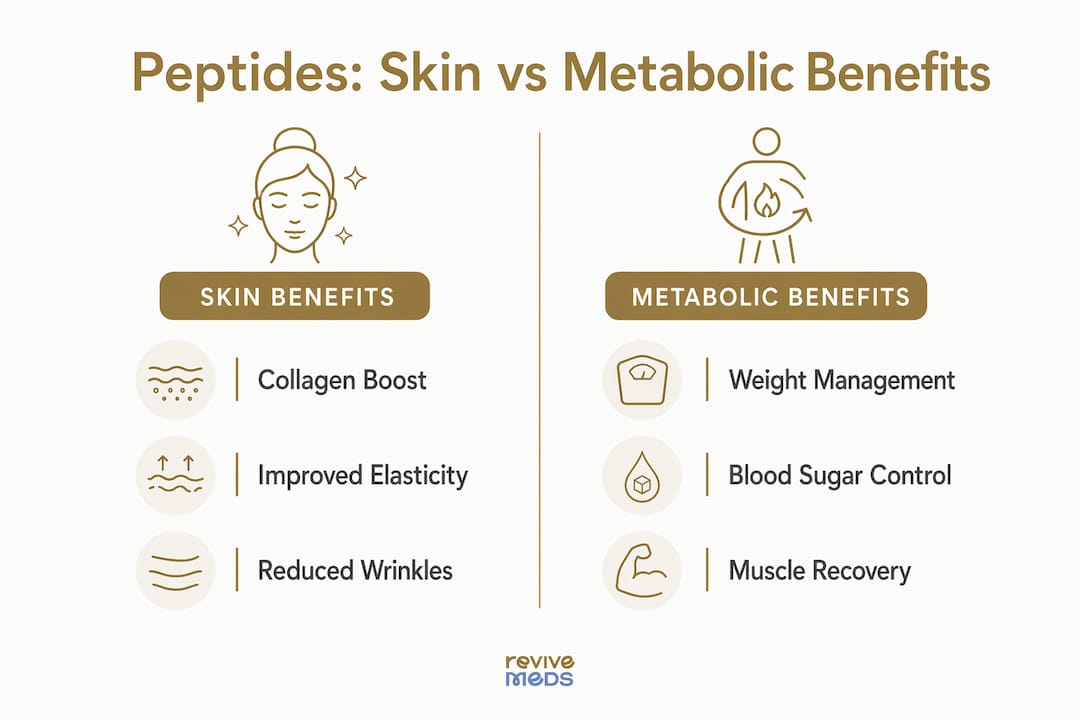
Topical peptides work by signaling fibroblasts to produce more collagen and elastin. Palmitoyl pentapeptide-4 (Matrixyl) is one of the most studied examples. GHK-Cu, a copper peptide, promotes wound healing and has shown antioxidant properties in laboratory studies. The catch is that most topical peptide research uses proprietary formulations at specific concentrations. A peptide listed on a product label does not guarantee the concentration is high enough to produce the same results seen in trials.
Pro Tip: When evaluating peptides for skin, look for products that list the peptide concentration and have published clinical data on that specific formulation, not just the ingredient class.
FDA-approved peptides and metabolic health
GLP-1 agonists like semaglutide are FDA-approved drugs for type 2 diabetes and weight management, with well-documented safety profiles and dosing guidelines built from large-scale clinical trials. These are the peptides with the most rigorous evidence behind them. They work by mimicking the natural GLP-1 hormone, slowing gastric emptying, reducing appetite, and improving insulin sensitivity.
| Peptide type | Clinical evidence | FDA status | Primary use |
|---|---|---|---|
| GLP-1 agonists (semaglutide) | Large-scale RCTs | Approved | Diabetes, weight loss |
| Collagen peptides (oral) | Multiple RCTs | GRAS (supplement) | Skin, joint support |
| BPC-157 | Mostly animal studies | Not approved | Marketed for recovery |
| GHK-Cu | Lab and small trials | Not approved | Skincare ingredient |
| TB-500 | Animal studies only | Not approved | Marketed for healing |
For injectable peptides marketed for anti-aging and recovery, clinical evidence remains extremely limited. One human trial on BPC-157 for knee pain involved only 10–12 participants. That is not enough data to draw conclusions about efficacy or safety.
Are peptides safe? Risks, regulation, and what you need to know
Safety depends entirely on which peptide you are talking about. The FDA approves specific peptides as drugs after rigorous clinical testing. Everything else occupies a different legal and safety category.
FDA-approved GLP-1 medications have known side effect profiles, standardized dosing, and manufacturing oversight. Unapproved peptides sold online operate in a different world entirely.
Here is what the regulatory picture actually looks like for unapproved wellness peptides:
- Sold as “research chemicals”: Most popular wellness peptides like BPC-157, TB-500, and GHK-Cu are labeled “not for human consumption” but are widely purchased and self-injected by consumers.
- No purity verification: Injectable peptides from unregulated suppliers often lack sterility assurance, meaning contamination is a real risk.
- Unknown dosing: Popular peptides like BPC-157 and GHK-Cu lack standardized dosing and human safety data, making consistent outcomes difficult to predict.
- No long-term data: Most experimental peptides have never been studied in humans beyond a few weeks.
- Legal gray zone: Marketing loopholes allow these products to evade FDA oversight, but that does not make them legal or safe for human use.
“The concern isn’t just whether peptides work. The concern is that people are injecting substances of unknown purity, at doses they found online, without any clinical oversight. That is a genuinely risky practice regardless of the compound involved.” — American Medical Association perspective on injectable peptides
The distinction between a GLP-1 prescription and a vial of BPC-157 ordered online is not a technicality. It is the difference between a medication with a known safety record and an experimental compound with no validated human data. Consulting a licensed clinician before using any injectable peptide is not optional. It is the minimum standard of care.
How are peptides used in wellness and fitness today?
Peptide use in wellness has expanded well beyond FDA-approved medications. The range of applications people pursue reflects both the genuine potential of peptides and the significant gap between animal research and human evidence.
Common wellness and fitness applications include:
- Weight management: GLP-1 agonists are the gold standard here, with proven clinical results. The peptide weight loss protocol under medical supervision produces consistent, measurable outcomes.
- Muscle growth and recovery: Peptides like CJC-1295 and Ipamorelin are marketed to stimulate growth hormone release. Evidence in healthy adults is limited to small studies.
- Skin anti-aging: Topical and oral collagen peptides have the strongest non-pharmaceutical evidence base, supported by multiple RCTs.
- Energy and libido: PT-141 (bremelanotide) is FDA-approved for hypoactive sexual desire disorder in women. Other energy-focused peptides lack comparable approval.
- Injury recovery: BPC-157 and TB-500 are popular in fitness communities for joint and tendon repair, but human trial data is minimal.
Administration methods range from subcutaneous injections and nasal sprays to topical creams and oral supplements. Injections deliver the highest bioavailability but carry the greatest risk when sourced from unregulated suppliers. Oral supplements are generally safer but face absorption challenges. Many amino acid chains break down in the digestive tract before reaching the bloodstream.
The trend toward peptide “stacks,” where people combine multiple unapproved compounds simultaneously, is particularly concerning. DIY peptide stacks combining multiple unapproved substances are unstudied combinations with no safety data. The interactions between compounds are unknown, and the risk of adverse effects compounds with each addition.
Pro Tip: Peptides work best as part of a structured protocol that includes adequate sleep, resistance training, and a whole-food diet. No peptide compensates for the fundamentals.
How do peptides compare to other health products?
Before adding any peptide to your routine, placing it alongside other options helps clarify the real tradeoffs.
| Category | Clinical evidence | Regulatory status | Key risk | Best for |
|---|---|---|---|---|
| FDA-approved peptides (GLP-1) | Strong, large RCTs | Approved drug | Known side effects, cost | Metabolic health, weight loss |
| Oral collagen peptides | Moderate, multiple RCTs | Dietary supplement | Low; mostly well tolerated | Skin, joints |
| Unapproved injectable peptides | Weak, mostly animal data | Unregulated | Contamination, unknown dosing | Experimental use only |
| Protein supplements (whey, casein) | Strong for muscle | Dietary supplement | Low | Muscle recovery, nutrition |
| Anabolic steroids | Moderate for muscle | Controlled substance | High; hormonal disruption | Not recommended for wellness |
The pattern is clear. The further a peptide sits from FDA approval, the less you know about what you are actually getting and what it will do. Purity, dosing, and source variability from unregulated suppliers make consistent outcomes difficult and risk assessment nearly impossible. Medical guidance is not just a recommendation in this space. It is the only way to know you are using a real compound at a safe dose.
Key Takeaways
Peptides with FDA approval have strong clinical evidence; most wellness peptides sold online do not, and the gap between those two categories defines the real risk.
| Point | Details |
|---|---|
| Peptides are biological messengers | Short amino acid chains that bind to cell receptors and trigger specific physiological responses. |
| Skin peptides have real evidence | A systematic review of 19 RCTs found measurable improvements in hydration, brightness, and wrinkle reduction. |
| GLP-1s are the gold standard | FDA-approved GLP-1 agonists have large-scale clinical trial data behind them; most other injectable peptides do not. |
| Unregulated peptides carry real risk | Products sold as research chemicals lack purity verification, standardized dosing, and long-term safety data. |
| Medical oversight is non-negotiable | A licensed clinician can distinguish safe, effective peptide protocols from experimental compounds with unknown risks. |
The peptide hype is real. So is the gap between promise and proof.
I have watched the peptide conversation shift from niche biohacker forums to mainstream wellness culture in a short span of time. That shift is not entirely bad. It has brought genuinely useful compounds like GLP-1 agonists into wider clinical use and pushed dermatologists to take collagen peptides seriously. But it has also created a market where people are injecting substances they found on Reddit, at doses they calculated themselves, from suppliers with no quality controls.
The uncomfortable truth is that most people asking about peptides are not asking about insulin or semaglutide. They are asking about BPC-157 or TB-500 or some stack they read about online. And for those compounds, the honest answer is: we do not have enough human data to know if they work, at what dose, or what the long-term effects are. Animal studies are promising. They are not proof.
What I find most useful is this framing: treat peptides the way you would treat any prescription medication. Ask who manufactured it, what the purity testing shows, what the clinical evidence says, and whether a licensed clinician has reviewed your specific situation. If you cannot answer those questions, you are not making an informed decision. You are making a bet.
The peptides worth your attention right now are the ones with actual regulatory approval and clinical data. Everything else deserves curiosity, not injection.
— Amy
Peptide therapy with real clinical oversight at Revive Meds
If you are ready to move past the noise and into a protocol that is actually backed by evidence, Revive Meds offers clinician-supervised peptide therapy with the oversight that makes the difference between results and risk.
Every patient at Revive Meds completes a full medical intake reviewed by a licensed clinician before anything is prescribed. Medications are US-compounded at FDA-registered pharmacies, 99%+ purity tested, and delivered to your door within 48–72 hours. For weight management, the GLP-1 Squared protocol combines FDA-approved GLP-1 therapy with clinical monitoring and unlimited provider messaging. For those exploring broader peptide options, the peptide benefits and safety guide covers what is approved, what works, and what to avoid. No membership fees. No guesswork. Real medicine with real oversight.
FAQ
What are peptides, exactly?
Peptides are short chains of 2–50 amino acids that act as biological messengers in the body. They regulate functions including metabolism, immune response, hormone signaling, and tissue repair.
Are peptides safe to use?
FDA-approved peptides like GLP-1 agonists have well-documented safety profiles from large clinical trials. Unapproved peptides sold online as research chemicals lack purity verification and long-term human safety data, making them significantly riskier.
Do peptides actually work for skin?
Yes, with qualifications. A systematic review of 19 RCTs found that oral and topical peptides produce measurable improvements in skin hydration, brightness, and wrinkle reduction. Results depend on the specific peptide, concentration, and formulation.
What is the difference between peptides and proteins?
Proteins are long chains of hundreds of amino acids. Peptides are shorter fragments of 2–50 amino acids. The shorter length allows peptides to cross cell membranes and bind to receptors more efficiently than intact proteins.
Do I need a prescription for peptide therapy?
FDA-approved peptides like GLP-1 agonists require a prescription. Many other peptides are sold without one, but that does not mean they are safe or legal for human use. A licensed clinician can determine which peptide protocols are appropriate for your specific health goals.