

GHK-Cu: The Copper Peptide Your Skin Has Been Missing

GHK-Cu, the copper complex of the tripeptide glycyl-L-histidyl-L-lysine, is one of the most thoroughly researched anti-aging molecules in dermatology. Your body produces it naturally, it circulates in plasma, saliva, and urine, and it plays a direct role in collagen synthesis, wound healing, and tissue repair. The problem is that GHK-Cu levels decline by approximately 60% between age 20 and 60, dropping from about 200 ng/mL to about 80 ng/mL. That drop correlates closely with the slowdown in collagen production and skin repair that most people start noticing in their 30s and 40s. Topical supplementation restores the copper-dependent signaling your skin depends on, supported by peer-reviewed research indicating safety and efficacy.
GHK-Cu’s primary roles in skin health:
- Stimulates synthesis of collagen types I, III, and V in dermal fibroblasts
- Promotes elastin production and dermal matrix remodeling
- Accelerates wound healing and skin barrier repair
- Delivers bioavailable copper for enzymatic cross-linking of structural proteins
- Reduces inflammation through antioxidant enzyme upregulation
- Supports skin thickness, density, and overall resilience over time
How does GHK-Cu actually work on your skin?
GHK-Cu functions through two distinct but complementary mechanisms. First, it acts as a copper carrier, delivering bioavailable copper directly to the enzymes that cross-link collagen and elastin fibers in the dermal matrix. Without adequate copper, those enzymes, particularly lysyl oxidase, cannot do their job, and the structural proteins that give skin its firmness lose tensile strength.
Second, GHK-Cu operates as a signal peptide, modulating gene expression across a wide range of pathways. Research shows it stimulates collagen types I, III, and V in dermal fibroblasts while simultaneously modulating thousands of genes involved in tissue repair and anti-inflammatory response. That breadth of activity is what separates it from simpler moisturizing peptides that work only at the surface.
The antioxidant side of GHK-Cu is equally well documented. It upregulates enzymes like superoxide dismutase, which neutralize free radicals and reduce the chronic low-grade inflammation often called “inflammaging.” Skin that ages under oxidative stress loses density faster, so this protective function compounds the collagen benefits over time.
Biochemical functions and cellular pathways activated by GHK-Cu:
- Copper delivery to lysyl oxidase for collagen and elastin cross-linking
- Fibroblast activation and upregulation of collagen types I, III, and V
- Gene modulation across tissue repair, antioxidant defense, and inflammation pathways
- Superoxide dismutase upregulation for free radical neutralization
- Reduction of pro-inflammatory cytokine activity
- Enhancement of glycosaminoglycan synthesis for skin hydration and structure
What results can you realistically expect from GHK-Cu?
Clinical data on topical GHK-Cu is more solid than most peptide ingredients can claim. A clinical study using 1–2% concentration applied twice daily showed up to 55.8% wrinkle volume reduction after 12 weeks of consistent use, alongside measurable gains in skin density and firmness. That is not a marketing claim. It comes from peer-reviewed research, and it holds up across independent lab replications.

The Leyden et al. trials add more granularity to the timeline. Participants showed significant improvement in skin elasticity at 4 weeks, more even skin tone at 8 weeks, and visible wrinkle repair at 12 weeks. Skin barrier function and hydration improve earlier than collagen remodeling does, which is why people with dry or compromised skin often notice a difference before the structural changes become visible.
What GHK-Cu does not do is match the speed of prescription retinoids or in-office procedures. Dermatologists are clear on this point: GHK-Cu is a supportive maintenance ingredient that builds long-term skin resilience rather than delivering immediate wrinkle reversal. Think of it as restoring your skin’s repair infrastructure rather than forcing a surface-level change.
| Outcome | Typical Timeframe | Evidence Level |
|---|---|---|
| Improved skin elasticity | 4 weeks | Clinical trial (Leyden et al.) |
| More even skin tone | 8 weeks | Clinical trial (Leyden et al.) |
| Wrinkle volume reduction (up to 55.8%) | 12 weeks | Peer-reviewed study |
| Increased skin density and firmness | 8–12 weeks | Multiple independent studies |
| Barrier repair and hydration | 2–4 weeks | Clinical observation |
Core benefits aligned with the clinical evidence:
- Measurable wrinkle volume reduction with consistent use over 12 weeks
- Improved skin elasticity and firmness starting around week 4
- Enhanced skin barrier function and hydration in early weeks
- Reduced inflammation and oxidative stress over time
- Gradual increase in skin density and structural integrity
- Better skin tone evenness with continued application
When do you start seeing changes? A realistic timeline
The first changes most people notice are not dramatic. Within the first two to four weeks, skin tends to feel more hydrated and less reactive. That reflects GHK-Cu’s early impact on barrier repair and inflammation reduction, not collagen remodeling, which takes longer.
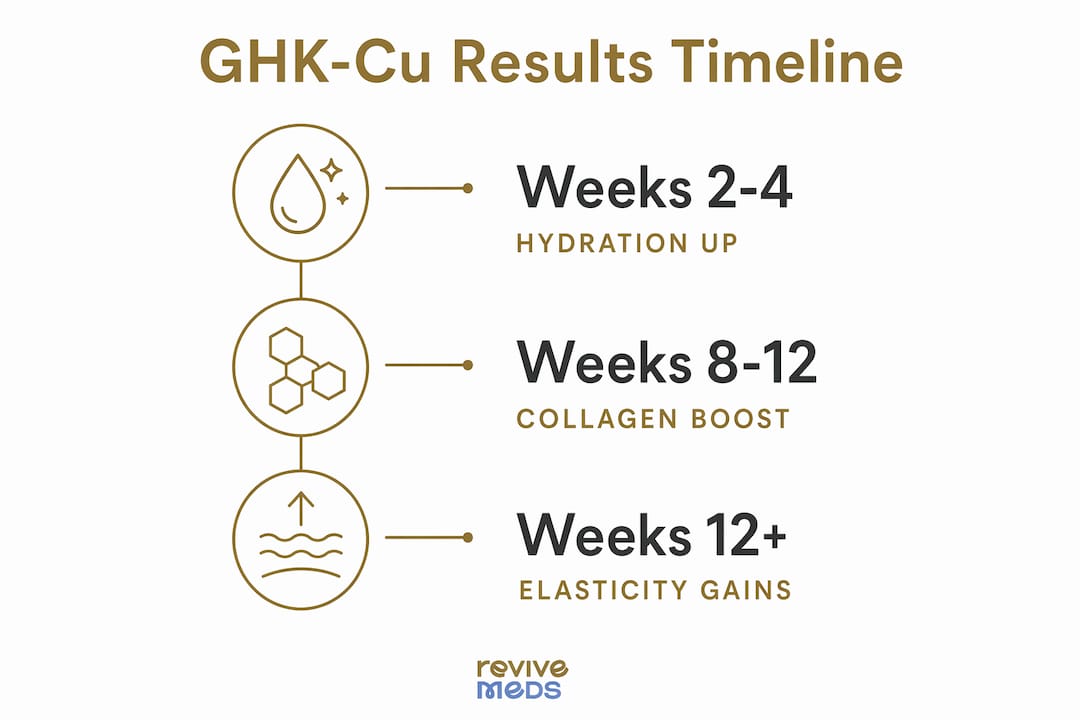
Collagen synthesis and skin density improvements emerge in the 8–12 week window, as clinical timelines confirm. Collagen remodeling is a gradual biological process, and no topical ingredient changes that fundamental pace. Expecting visible structural improvement before week 8 sets you up for disappointment.
Long-term use beyond 12 weeks is where GHK-Cu earns its place in a routine. Skin that has been consistently supported with copper peptide signaling tends to maintain density and resilience better than skin that cycles on and off actives. Consistency is the variable that separates good results from great ones.
Usage timeline milestones:
- Weeks 1–4: Improved hydration, reduced sensitivity, early barrier repair
- Weeks 4–8: Noticeable improvement in elasticity and skin tone evenness
- Weeks 8–12: Measurable wrinkle reduction, increased skin density and firmness
- Beyond 12 weeks: Sustained collagen support, maintained skin resilience, long-term structural benefit
Who should add GHK-Cu to their skincare routine?
GHK-Cu fits a wide range of skin concerns, but it is especially well suited to people whose skin needs repair support rather than aggressive renewal. Adults in their 30s and beyond who are seeing early signs of thinning, loss of firmness, or slower wound healing are the clearest candidates. The age-related decline in plasma GHK-Cu levels is the biological rationale, and topical application directly addresses that gap.
People with sensitive or reactive skin who cannot tolerate retinoids get particular value here. GHK-Cu promotes natural repair rather than forcing accelerated cell turnover, so it produces far less irritation than retinol-based products while still stimulating collagen. Post-procedure skin, whether after a chemical peel, laser treatment, or microneedling, also responds well because GHK-Cu accelerates the healing process without adding stress to already-compromised tissue.
Where to be more cautious: acne-prone skin can sometimes react to occlusive formulations that pair with copper peptides, so product selection matters. Anyone expecting dramatic, fast results comparable to in-office treatments will likely feel underwhelmed. GHK-Cu rewards patience and consistency, not urgency.
Ideal candidates for GHK-Cu based on dermatologist perspectives:
- Adults 30+ experiencing visible signs of collagen loss or skin thinning
- Sensitive or reactive skin types intolerant to retinoids
- Post-procedure skin needing accelerated healing support
- Skin with a compromised barrier from environmental damage or over-exfoliation
- Anyone seeking long-term skin resilience over quick cosmetic fixes
- People with fragile or mature skin requiring gentle yet effective repair
Safety and side effects: what you need to know
GHK-Cu has a well-established safety record. At standard topical concentrations, it is generally well tolerated with a much lower irritation risk than retinoids or alpha hydroxy acids. Most people use it without any adverse reaction at all.
That said, higher concentrations or improper use can cause mild redness, tingling, or temporary sensitivity. These effects are more common when GHK-Cu is layered directly over strong exfoliating acids or high-dose vitamin C, which can alter skin pH and interfere with peptide stability. The caution around concurrent use with these actives is worth taking seriously, not because GHK-Cu is dangerous, but because the combination can reduce efficacy and increase irritation simultaneously.
If redness or sensitivity appears, reducing application frequency is the right first step. Discontinuing temporarily and reintroducing at a lower frequency usually resolves the issue without needing to abandon the ingredient entirely.
Pro Tip: Apply GHK-Cu to clean, dry skin before heavier moisturizers or sunscreen. Layering it under occlusives traps the peptide against the skin surface and supports absorption. Avoid applying it immediately after strong acids or vitamin C serums in the same routine.
Possible side effects and precautions:
- Mild redness or tingling, particularly at higher concentrations
- Temporary sensitivity in reactive skin types
- Reduced efficacy when layered over strong acids or vitamin C
- Risk of inflammation with overuse or excessive concentration
- Caution advised for acne-prone skin with occlusive formulations
How does GHK-Cu compare to other peptides and anti-aging ingredients?
Most peptides in skincare fall into one of a few functional categories: signal peptides that tell cells to produce more collagen, carrier peptides that deliver trace elements, and neurotransmitter-inhibiting peptides that relax facial muscles. GHK-Cu is a carrier peptide, but it also functions as a signal peptide, which gives it a broader mechanism than most.
Compared to retinoids, GHK-Cu stimulates collagen through a fundamentally different pathway. Retinoids accelerate cell turnover and directly upregulate collagen gene expression, producing faster visible results but also more irritation, photosensitivity, and a required adjustment period. GHK-Cu builds collagen more gradually by restoring the copper-dependent enzymatic environment that supports natural fibroblast activity. The tolerability advantage is real and clinically documented, particularly for sensitive skin.
GHK-Cu is not a retinoid substitute for someone chasing rapid wrinkle reversal. It is the better choice for long-term skin resilience, barrier support, and anyone who has found retinoids too aggressive. The two can also be used in the same routine on alternating days, which many dermatologists recommend for people who want both mechanisms working together.
Comparison across key dimensions:
- Mechanism: GHK-Cu delivers copper and signals repair; other peptides target neurotransmitters or surface hydration
- Speed of results: Retinoids work faster; GHK-Cu builds more gradually but with less disruption
- Tolerability: GHK-Cu is gentler than retinoids, suitable for sensitive and reactive skin
- Long-term benefit: GHK-Cu supports structural resilience; retinoids require ongoing use to maintain effects
- Compatibility: GHK-Cu pairs well with most actives except strong acids and high-dose vitamin C in the same step
What factors shape how your skin responds to GHK-Cu?
Age is the most significant variable. Younger skin has more active fibroblasts and a stronger baseline repair capacity, so it tends to respond faster and more visibly to GHK-Cu. Older skin still benefits, but the collagen remodeling process is slower, and individual results vary based on the degree of existing damage and the skin’s remaining regenerative capacity.
Concentration and frequency matter too. The clinical evidence centers on 1–2% GHK-Cu applied twice daily. Products below that threshold may not deliver enough active molecule to stimulate meaningful fibroblast activity. Products above it are not necessarily better and can increase irritation risk without proportional benefit.
Product formulation affects how much GHK-Cu actually reaches the dermis. A well-designed serum with a low molecular weight delivery system will outperform a poorly formulated cream at the same concentration. Skin preparation also plays a role: clean skin with an intact but not over-stripped barrier allows better peptide penetration than skin that has been aggressively exfoliated immediately before application.
Factors that collectively influence outcome variability:
- Age and baseline fibroblast activity
- GHK-Cu concentration in the product (optimal range: 1–2%)
- Application frequency (twice daily is the clinically studied standard)
- Product formulation quality and delivery system
- Skin preparation and layering order
- Concurrent actives and their potential to interfere with peptide stability
- Individual genetic factors and degree of existing photodamage
Clinical insights and dermatologist best practices for GHK-Cu
The topical evidence base for GHK-Cu is among the strongest of any cosmetic peptide. Multiple independent studies confirm its efficacy for collagen stimulation and skin remodeling, and the research spans decades rather than a single wave of industry-funded trials. That depth of independent validation is what gives dermatologists confidence recommending it as a long-term routine ingredient.
Injectable GHK-Cu is a different story. No published randomized controlled trials or pharmacokinetic data exist for injectable forms in humans. The promising results seen in animal and in vitro studies cannot be extrapolated to human injectable use without that foundational safety and efficacy data. Anyone considering injectable GHK-Cu should approach it with significant caution and demand evidence before proceeding.
Dermatologists consistently frame GHK-Cu as a reinforcement ingredient, not a quick fix. It works best as part of a routine that also addresses UV protection, hydration, and where appropriate, other evidence-backed actives. The comprehensive skincare approach that includes GHK-Cu alongside sunscreen and barrier support consistently outperforms any single-ingredient strategy.
Pro Tip: Apply GHK-Cu serum to clean skin before any occlusive moisturizer or sunscreen. This layering order allows the peptide to penetrate the epidermis and reach fibroblasts in the dermis, where collagen and elastin synthesis actually happens.
Clinical best practices:
- Use topical GHK-Cu at 1–2% concentration, twice daily, for at least 12 weeks to assess full benefit
- Apply to clean skin before occlusives to support dermal penetration
- Avoid injectable GHK-Cu formulations lacking published human clinical trial data
- Choose products from manufacturers with transparent formulations and independent testing
- Pair with sunscreen daily, since UV damage directly counteracts collagen synthesis gains
- Treat GHK-Cu as a long-term maintenance ingredient, not a short-term treatment
How to choose a quality GHK-Cu product
The market for copper peptide skincare has grown considerably, and product quality varies widely. Concentration is the starting point: look for products that list GHK-Cu at 1–2% and state it clearly on the label or in published formulation details. Products that list “copper peptide complex” without specifying GHK-Cu or its concentration are worth scrutinizing more carefully.
Formulation type affects delivery. Serums with lightweight, water-based bases generally allow better penetration than thick creams, particularly when applied as the first active step on clean skin. Stability matters too: GHK-Cu can degrade in formulations with extreme pH levels or when combined with certain oxidizing ingredients, so products designed with peptide stability in mind will maintain potency through the product’s shelf life.
Third-party testing and transparent ingredient sourcing are the clearest markers of a reputable product. Brands that publish certificates of analysis, use FDA-registered compounding facilities, and avoid proprietary blends that obscure actual concentrations give you the most confidence that what is on the label is what is in the bottle. For those interested in peptide therapy options that go beyond over-the-counter skincare, clinically supervised protocols offer a higher level of formulation oversight and personalized guidance.
What to look for when selecting a GHK-Cu product:
- Clearly stated GHK-Cu concentration at 1–2%
- Lightweight serum formulation for optimal skin penetration
- pH-stable formula designed to preserve peptide integrity
- Third-party testing or certificate of analysis from the manufacturer
- No competing oxidizing ingredients in the same formula
- Transparent ingredient sourcing and manufacturing standards
- Avoid products relying on vague “copper peptide complex” labeling without specifics
Key Takeaways
GHK-Cu restores copper-dependent collagen signaling that declines with age, producing measurable skin improvements in density, elasticity, and wrinkle volume with consistent topical use over 8–12 weeks.
| Point | Details |
|---|---|
| GHK-Cu declines with age | Plasma levels drop approximately 60% between age 20 and 60 (from about 200 ng/mL to about 80 ng/mL), directly reducing collagen repair capacity. |
| Clinical results take time | Studies show up to 55.8% wrinkle volume reduction after 12 weeks at 1–2% concentration applied twice daily. |
| Tolerability advantage | GHK-Cu produces significantly less irritation than retinoids, making it suitable for sensitive and reactive skin. |
| Application order matters | Apply to clean skin before occlusives to allow peptide penetration to the dermis where fibroblasts are active. |
| Injectable forms lack evidence | No published human clinical trials or pharmacokinetic data exist for injectable GHK-Cu; topical use is the validated route. |