

Child Genius: A Parent and Educator’s Guide

A child genius is a young person whose intellectual capabilities far exceed those typical of their age group, requiring specialized educational and emotional support to reach their full potential. Under the Every Student Succeeds Act (ESSA) of 2015, gifted students show high capability in intellectual, creative, artistic, or leadership domains and need services not typically provided in general classrooms. Research from NSW educational standards shows that gifted students may have already mastered 40–50% of the standard curriculum before instruction even begins. That statistic alone explains why so many exceptionally gifted children disengage, act out, or underperform in traditional school settings. Recognizing giftedness as a developmental difference, not just a badge of honor, is the first step toward giving these children what they actually need.
What are the signs of a child genius?
The term “child genius” is widely used, but the formal term in education and psychology is gifted learner. A child prodigy is a more specific category: an individual under age 10 producing output at an adult expert level in a specific domain. Think of Mozart composing minuets at age five or Terence Tao solving university-level math problems before adolescence. Most gifted children do not reach that extreme, but they still display a recognizable cluster of traits.
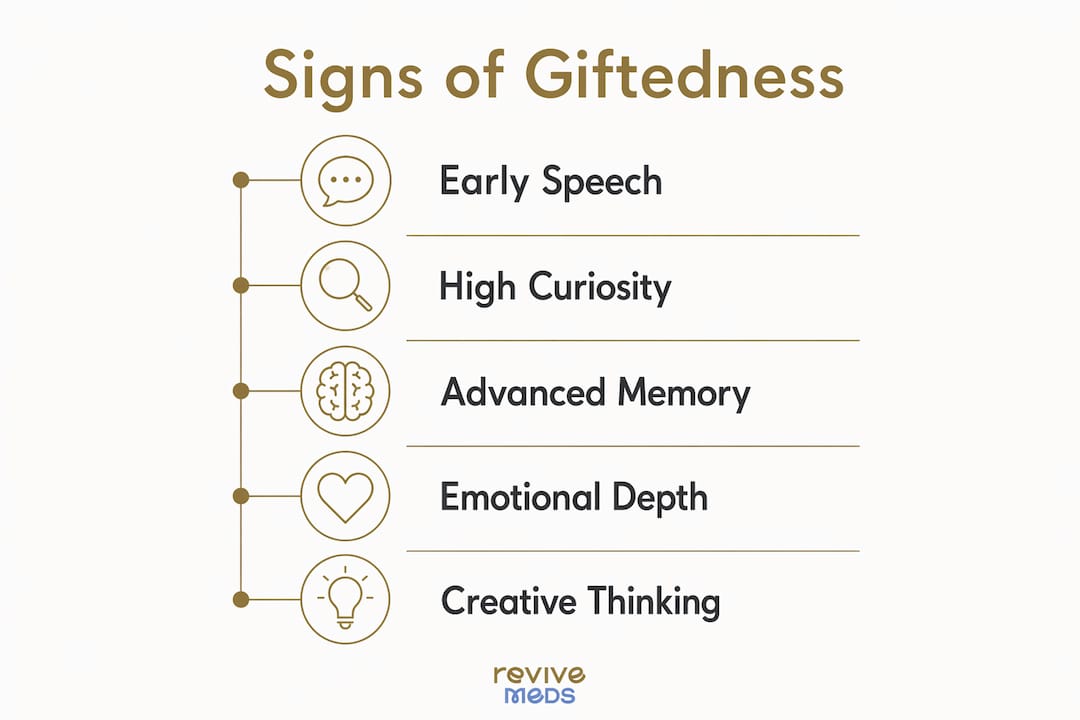
Giftedness manifests across intellectual, emotional, and social domains and varies widely across cultures and individuals. It is never just a high test score. Parents and educators who look only at grades often miss the full picture.
Intellectual traits commonly seen in gifted children:
- High processing speed and intense curiosity, leading to rapid knowledge acquisition
- Advanced reasoning and the ability to spot patterns others miss
- Strong analytical thinking and a preference for complex problems
- Exceptional memory and the ability to make connections across subjects
Social and emotional traits:
- Perfectionism and a strong internal drive for accuracy
- Emotional intensity, sometimes called “overexcitabilities”
- Heightened sensitivity to fairness, injustice, and the feelings of others
- Difficulty relating to age peers, often preferring older children or adults
Asynchronous development is one of the most misunderstood features of giftedness. A child may read at a tenth-grade level while still crying over a lost toy like any other six-year-old. Gifted children may excel intellectually while showing emotional or social responses typical of their chronological age. Parents and teachers who expect uniform maturity across all areas set these children up for frustration.
One group that deserves special attention is twice-exceptional learners. Twice-exceptional children are gifted but also have learning disabilities, and their giftedness often masks the disability, or the disability masks the giftedness. A child with dyslexia and a 145 IQ may look like an average student on paper. Identifying them requires looking well beyond a single test score.
How should education be adapted for gifted kids?
Standard classroom instruction leaves most gifted children underchallenged. Four core strategies address this gap: differentiated instruction, acceleration, enrichment, and extension.
- Differentiated instruction adjusts the depth, pace, and complexity of content within the existing classroom. A teacher might assign a gifted student a research project while peers complete a worksheet on the same topic.
- Acceleration moves a student through content faster, whether through grade skipping, subject-specific advancement, or early college enrollment. Acceleration produces positive academic results without social harm when paced to the child’s emotional readiness.
- Enrichment adds breadth rather than speed. Science Olympiad, math competitions, debate clubs, and mentorship programs all fall here. These experiences build skills that no textbook covers, including resilience, collaboration, and creative problem-solving.
- Extension deepens understanding of existing content rather than moving on. A gifted student studying the American Revolution might analyze primary sources and write a persuasive essay from a loyalist perspective instead of answering comprehension questions.
Regular, formative assessment helps tailor education to a gifted child’s evolving needs and prevents disengagement. Without ongoing evaluation, even a well-designed program can fall behind a fast-moving learner.
Flexible grouping matters too. Placing gifted students together for specific subjects, not all day, gives them intellectual peers without isolating them socially. Mentoring programs that connect young learners with domain experts produce measurable gains in motivation and depth of knowledge.

Pro Tip: Before accelerating a child academically, assess their emotional resilience and anxiety levels as carefully as their intellectual readiness. A child who is academically ready but socially anxious may struggle more than they gain from skipping a grade.
Gifted children underachieve due to boredom or lack of challenge far more often than due to behavioral problems. When a gifted child acts out or shuts down, the first question should be whether the curriculum is meeting their needs, not whether the child needs discipline.
What challenges do parents and educators face with gifted children?
Supporting a gifted child is not simply a matter of finding harder books. The challenges are layered, and many parents encounter them without warning.
Common obstacles and how to address them:
- Asynchronous development creates mismatched expectations. A child who debates philosophy at dinner may still need help managing bedtime anxiety. Treat each domain of development separately and resist the urge to expect adult behavior because of adult-level intellect.
- Emotional overexcitabilities mean gifted children often feel things more intensely than peers. Frustration, perfectionism, and existential worry appear early and can look like anxiety disorders. Connecting with a counselor who understands giftedness makes a real difference. Parents exploring therapy options for kids will find that not all approaches are equally suited to gifted learners.
- Twice-exceptional identification failures leave many children without the support they need. A gifted child with ADHD may compensate so well that neither the giftedness nor the ADHD gets flagged. Counseling for ADHD that accounts for giftedness looks very different from standard ADHD intervention.
- Over-focus on acceleration is a trap many parents fall into. Parents often focus too heavily on acceleration while neglecting the social and emotional preparedness of their child. Pushing a nine-year-old into high school classes may produce short-term academic wins and long-term social isolation.
- School resistance is real. Many teachers are not trained in gifted education and may view a gifted child’s questions as disruptive rather than curious. Parents who face school-related challenges with their gifted child benefit from a structured advocacy plan.
Pro Tip: Document your child’s strengths and challenges in writing before any school meeting. Specific examples carry far more weight than general descriptions, and they keep the conversation focused on the child’s actual needs.
Perfectionism deserves its own attention. Many gifted children refuse to attempt tasks they might not do perfectly. This is not laziness. It is a fear of failure that grows when a child has always been praised for being “the smart one.” Shifting praise from intelligence to effort and process, a technique supported by Carol Dweck’s growth mindset research, reduces perfectionism over time.
How to identify and assess child geniuses effectively?
Identification is where the system most often fails gifted children. A single IQ test is not sufficient, and high achievement in school is not the same as giftedness.
| Assessment method | Strengths | Limitations |
|---|---|---|
| Psychoeducational evaluation | Measures multiple cognitive domains; identifies twice-exceptional learners | Expensive; access varies by location |
| Teacher rating scales | Low cost; captures classroom behavior over time | Subject to bias; may miss underachievers |
| Parent and family input | Captures home behavior and early development | May overestimate or underestimate ability |
| Standardized achievement tests | Objective; widely available | Ceiling effects limit accuracy for highly gifted students |
| Portfolio and performance assessment | Shows depth of thinking and creativity | Time-intensive; harder to standardize |
Assessment must include multiple measures and perspectives to identify gifted learners accurately, especially those who are twice-exceptional or from diverse backgrounds. Gifted girls are frequently underidentified because they often mask their abilities to fit in socially. Children from low-income families or non-English-speaking households are also consistently missed when identification relies solely on teacher referrals or English-language tests.
Ongoing collaboration between educators, parents, and mental health professionals is vital for a gifted child’s development. Identification is not a one-time event. A child’s profile changes as they grow, and assessment should be revisited when behavior, achievement, or emotional wellbeing shifts significantly.
Key Takeaways
Gifted children require individualized educational and emotional support because their intellectual development consistently outpaces what standard classrooms provide.
| Point | Details |
|---|---|
| Giftedness is multidimensional | Intellectual, emotional, and social traits all define a gifted child, not test scores alone. |
| Curriculum mastery gap is real | Gifted students may have mastered 40–50% of content before instruction begins, making differentiation urgent. |
| Twice-exceptional learners need nuanced assessment | Giftedness and learning disabilities can mask each other, requiring holistic evaluation. |
| Acceleration requires emotional readiness | Academic advancement produces the best outcomes when matched to a child’s social and emotional maturity. |
| Ongoing assessment prevents disengagement | Regular formative evaluation keeps educational plans aligned with a fast-moving learner’s actual needs. |
What I’ve learned about nurturing giftedness without losing the child
The conversation around child geniuses tends to focus on what these kids can do. The harder question is who they are allowed to be.
I have seen parents pour enormous energy into finding the right accelerated program, the right competition, the right mentor, and then wonder why their child is anxious, withdrawn, or resistant. The intellectual gifts are real. The pressure those gifts attract is also real. What gets lost in between is the child’s own sense of what they enjoy, what they fear, and what they need.
The most effective support I have observed combines high expectations with genuine patience. It means asking a gifted child what they find hard, not just what they find easy. It means letting them fail at something without treating it as a crisis. And it means keeping the lines of communication open between parents, teachers, and the child, because gifted children often carry worries they do not know how to name.
Giftedness is not a problem to solve. It is a developmental profile to understand. The families and educators who approach it that way consistently produce children who are not just academically accomplished but genuinely well.
— Amy
Supporting your family’s wellbeing beyond the classroom
Raising a gifted child involves more than academic planning. The emotional intensity, anxiety, and social complexity that often accompany giftedness can affect the whole family, and parents deserve support too.

Revive Meds is a licensed telehealth platform built for people who are doing everything right and still feel like something is off. Whether you are a parent running on empty or an adult navigating the long-term effects of chronic stress, Revive Meds offers clinician-reviewed care with no waiting rooms and no one-size-fits-all plans. Every protocol starts with a full medical intake reviewed by a licensed clinician. Learn more about how telehealth prescriptions work and whether Revive Meds’ hormone and metabolic support options are right for you.
FAQ
What is the difference between a gifted child and a child prodigy?
A child prodigy is specifically defined as an individual under age 10 producing output at an adult expert level in a single domain. Giftedness is broader, covering high capability across intellectual, creative, artistic, or leadership areas without requiring prodigy-level performance.
How do I know if my child is gifted or just a high achiever?
High achievers perform well within the existing curriculum, while gifted children often exceed it significantly and show advanced reasoning, intense curiosity, and asynchronous development. A psychoeducational evaluation that measures multiple cognitive domains provides the most accurate picture.
Can a gifted child also have a learning disability?
Yes. Twice-exceptional children are gifted and have a learning disability simultaneously, and each condition can mask the other. Holistic assessment that looks at both strengths and challenges is the only reliable way to identify these learners.
What is asynchronous development in gifted children?
Asynchronous development means a gifted child’s intellectual, emotional, and physical growth do not advance at the same rate. A child may reason at a high school level while still experiencing the emotional responses of a typical six-year-old.
Is grade skipping harmful for gifted children?
Research shows acceleration produces positive academic outcomes without social harm when it is matched to the child’s emotional readiness, not just their intellectual ability. Decisions should involve the child, parents, and educators working together with a full picture of the child’s social and emotional maturity.