

HRT Code Explained: Insurance Billing Guide for 2026

An HRT code is a standardized medical billing code assigned to hormone replacement therapy services, including hormone lab tests and implantation procedures, used to file insurance claims and secure reimbursement. The two main code systems are CPT (Current Procedural Terminology) and ICD-10 (International Classification of Diseases, 10th Revision). Getting these codes right determines whether your insurer pays or denies the claim. This guide breaks down every major HRT code you need to know in 2026, explains the documentation rules that drive approvals, and shows you how to avoid the most common billing mistakes.
What are the main HRT CPT codes used in hormone replacement therapy?
Standard CPT codes for routine hormone testing include four core lab tests and one procedure code. Each one maps to a specific service, and each requires documented medical necessity before an insurer will pay.
| CPT Code | Service | Billing Notes |
|---|---|---|
| 84443 | Thyroid Stimulating Hormone (TSH) | Most frequently denied; requires specific medical necessity documentation |
| 84403 | Testosterone, Total | Ordered for low-T evaluation; not specialty-restricted |
| 82670 | Estradiol | Used in menopause and fertility workups |
| 84480 | T3 Total | Often denied when ordered reflexively without separate justification |
| 11980 | Subcutaneous hormone pellet implantation | Billed per pellet inserted; insurance reimbursement is rare |

None of these codes are restricted to a specific specialty. Any licensed provider can order them, as long as the chart supports medical necessity. That last point is where most billing problems start.
CPT 11980 deserves special attention. It covers subcutaneous hormone pellet implantation, and it is billed per pellet, not per session. If a provider inserts three pellets in one visit, the code appears three times on the claim. Insurance reimbursement for pellet insertion remains rare, and prior authorization is almost never guaranteed. Providers who skip that step routinely face full denials.
Pro Tip: Before ordering any hormone panel, confirm that each individual test has its own documented clinical reason in the chart. A blanket order for a “hormone panel” without symptom-specific justification is the fastest route to a denial.
For patients managing menopause-related billing, the CPT code for menopause guide from Revive-meds covers additional procedure and diagnosis code combinations relevant to that population.
How do diagnosis codes affect HRT billing and insurance reimbursement?
The main cause of insurance denials on HRT testing is not the CPT codes themselves. The real problem is inadequate diagnosis code alignment with the lab tests ordered. ICD-10 codes tell the insurer why the test was necessary. Without the right ICD-10 code attached, even a perfectly valid CPT code gets denied.
Common ICD-10 codes used in HRT billing include:
- E29.1 (Testicular hypofunction): Used to justify testosterone testing and therapy in men
- Z79.890 (Long-term use of hormone replacement therapy): Documents ongoing HRT status for monitoring claims
- N95.1 (Menopausal and female climacteric states): Supports estradiol and FSH testing in perimenopausal and postmenopausal patients
- E28.319 (Premature ovarian failure, unspecified): Used when early menopause drives the HRT need
- E34.9 (Endocrine disorder, unspecified): A fallback code, but payers often reject it as too vague
Specific codes consistently outperform generic ones. A claim using E29.1 with a testosterone test tells a clear clinical story. A claim using E34.9 for the same test raises a red flag with the payer’s review team.
ICD-10 codes like E29.1 and Z79.890 are the standard pairing for hormone pellet insertion claims. Providers who use Z79.890 alone, without a supporting symptom or diagnosis code, often see denials because the code documents ongoing therapy but does not establish the original medical need.
Pro Tip: Link every diagnosis code directly to a specific symptom noted in the visit record and a corresponding lab value. That three-way connection, symptom plus lab result plus ICD-10 code, is the strongest defense against a payer denial.
What are the common billing errors with HRT codes?
Billing errors in hormone replacement therapy fall into predictable patterns. Knowing them in advance saves significant time and money.
-
Under-documentation of medical necessity. TSH (84443) is one of the most frequently denied lab codes in hormone billing. Providers order it routinely, but the chart often lacks a specific symptom or diagnosis tying the test to a clinical question. Payers reject it because the documentation does not meet their medical necessity criteria.
-
Reflexive T3 Total ordering. CPT 84480 (T3 Total) triggers unnecessary denials when ordered as part of a standard thyroid panel without a separate documented reason. Insurers require individual justification for T3 Total, distinct from the TSH and T4 orders placed at the same visit.
-
Incorrect modifier usage on pellet insertion. Modifier -59 may be required when billing multiple pellets in a single session to indicate each insertion is a distinct procedural service. Skipping this modifier, or applying it incorrectly, is a common denial trigger. Payer requirements vary, so confirm before submitting.
-
Missing prior authorization for pellet procedures. CPT 11980 rarely gets paid without prior authorization. Providers who assume coverage without verifying payer-specific policies first face full claim denials and difficult appeals.
-
High testing volumes triggering audits. Monitoring HRT through hormone testing at volumes significantly higher than peer providers can trigger payer audits. This is especially true for testosterone and estradiol panels ordered at every visit. Every test needs its own documented reason, every time.
-
Using HCPCS codes incorrectly for pellet products. Billing the pellet product itself requires a separate HCPCS code. HCPCS J3490 covers compounded pellets, while J3121 applies to FDA-approved testosterone pellets. Mixing these up, or omitting the product code entirely, creates billing gaps that delay payment.
The pattern across all six errors is the same. Documentation gaps and payer-specific policy oversights cause far more denials than incorrect CPT code selection.
How can patients and providers navigate HRT insurance coverage?
Getting HRT claims paid consistently requires a proactive process, not a reactive one. Verifying payer-specific coverage policies before ordering any hormone test is the single most effective step a provider can take.
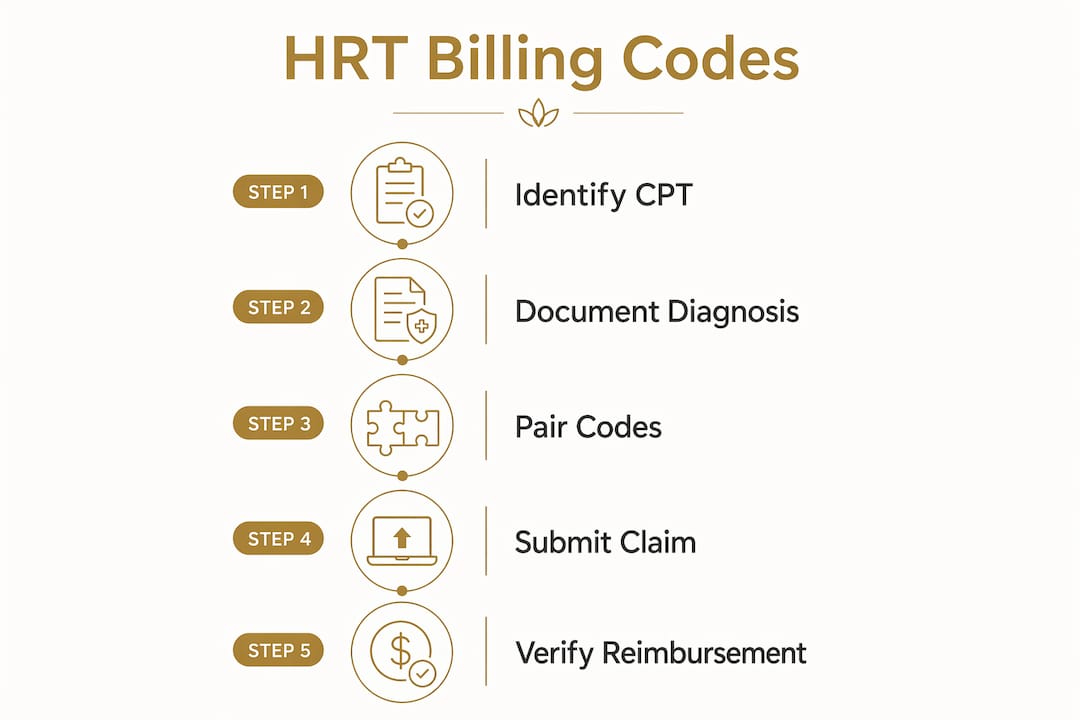
Here is a practical approach that works:
- Verify coverage before the visit. Call the payer or check the provider portal to confirm which hormone tests are covered, what diagnosis codes they accept, and whether prior authorization is required for pellet insertion.
- Document symptoms at every visit. Each chart note should record the specific symptoms driving the hormone test order. “Fatigue, low libido, and lab-confirmed low testosterone” is billable. “Hormone check” is not.
- Pair every CPT code with a matching ICD-10 code. Accurate documentation linking symptoms, lab results, and diagnosis codes is the best defense against denials and audits. Do not leave any CPT code without a supporting diagnosis.
- Request prior authorization for CPT 11980 in writing. Get the authorization number before the procedure. Keep a copy in the patient’s file.
- Use the correct HCPCS code for the pellet product. Bill J3121 for FDA-approved testosterone pellets and J3490 for compounded formulations. These are separate line items from the insertion procedure code.
- Appeal denied claims with clinical evidence. A denial is not final. Attach the lab results, the visit note, and the ICD-10 linkage to the appeal. Payers reverse well-documented appeals more often than providers expect.
- Use provider messaging to coordinate care and billing. Ongoing provider communication reduces the chance of documentation gaps between visits, which is one of the top reasons claims get flagged on resubmission.
Insurance companies apply the same CLIA certification and documentation standards to hormone testing regardless of whether a specialist or a primary care provider orders it. That means a family medicine doctor ordering testosterone labs faces the same scrutiny as an endocrinologist. The documentation standard is identical.
Key Takeaways
Accurate HRT billing requires pairing the correct CPT code with a specific ICD-10 diagnosis code, supported by documented symptoms and lab results at every visit.
| Point | Details |
|---|---|
| Core CPT codes | 84443, 84403, 82670, 84480, and 11980 cover the most common HRT tests and pellet insertion. |
| ICD-10 code specificity | Specific codes like E29.1 and N95.1 outperform generic codes and reduce denial rates. |
| Pellet billing complexity | CPT 11980 is billed per pellet; modifier -59 and prior authorization are often required. |
| Documentation is the defense | Linking symptoms, lab values, and diagnosis codes in every chart note is the strongest protection against audits. |
| Proactive payer verification | Checking payer-specific policies before testing prevents the majority of avoidable denials. |
What I’ve learned about HRT coding after years of watching claims get denied
The most frustrating thing about HRT billing is that the denials are almost always preventable. Providers know the CPT codes. The problem is that they treat documentation as an afterthought rather than the core of the billing process.
Payer scrutiny on hormone testing has increased noticeably. Insurers are paying closer attention to testing frequency, and providers who order testosterone and estradiol panels at every visit without fresh documentation are drawing audit attention they do not need. The fix is not to order fewer tests. The fix is to write better chart notes.
Coding updates and payer policy changes happen faster than most providers track. A coverage policy that approved TSH testing last year may now require a specific symptom code that did not exist in the prior version. Staying current means checking payer bulletins quarterly, not just at the start of the year.
The providers who consistently get HRT claims paid share one habit. They treat every chart note as if a payer reviewer will read it. Symptom, lab value, diagnosis code, clinical rationale. That four-part structure turns a generic visit note into a billable document that holds up under review.
For patients, the takeaway is simpler. Ask your provider to document your symptoms and lab results in writing at every visit. That record is your best tool if a claim gets denied and you need to appeal.
— Amy
Hormone therapy and whole-body care at Revive-meds
Navigating HRT billing is complex, but getting the right therapy should not be.
Revive-meds is a licensed telehealth clinic that integrates hormone support with whole-body care, including peptides and metabolic therapy. All medications are US-compounded at FDA-registered pharmacies, clinician-reviewed before every order ships, and delivered to your door in 48–72 hours. There are no membership fees and no waiting rooms. Patients get unlimited provider messaging, which means documentation gaps between visits are far less likely. HSA and FSA payments are accepted. If you are exploring peptide and hormone options as part of a broader care plan, Revive-meds offers clinician-guided protocols built around your specific labs and symptoms.
FAQ
What is an HRT code in medical billing?
An HRT code refers to the CPT and ICD-10 codes used to document and bill hormone replacement therapy services, including lab tests and implantation procedures, for insurance reimbursement.
What CPT code is used for hormone pellet insertion?
CPT 11980 is the standard code for subcutaneous hormone pellet implantation. It is billed per pellet inserted, and insurance reimbursement requires prior authorization and detailed medical necessity documentation.
Why do HRT insurance claims get denied so often?
The most common reason is inadequate documentation. Claims fail when the ICD-10 diagnosis code does not clearly support the CPT code ordered, or when the chart note lacks specific symptom and lab result linkage.
What ICD-10 codes are used with HRT billing?
Common ICD-10 codes include E29.1 (Testicular hypofunction), Z79.890 (Long-term hormone replacement therapy), and N95.1 (Menopausal and female climacteric states). Specific codes reduce denials compared to generic endocrine disorder codes.
What HCPCS codes apply to hormone pellet products?
HCPCS J3490 covers compounded hormone pellets, while J3121 applies to FDA-approved testosterone pellets. These product codes are billed separately from the CPT 11980 insertion procedure code.