

Telehealth vs In-Person Care: What You Need to Know

Telehealth is defined as the delivery of health services through electronic communication technologies, including video calls, phone consultations, and digital monitoring, without requiring a physical visit. In-person care, by contrast, involves direct face-to-face clinical interaction where a provider can examine, test, and treat you on the spot. Understanding what telehealth vs in-person care actually means, and when each applies, is the difference between getting the right care quickly and wasting time in the wrong setting. According to the Centers for Medicare and Medicaid Services, telehealth covers assessment, diagnosis, consultation, and patient education delivered across distance in real time.
What is telehealth vs in-person care, and how do they differ?
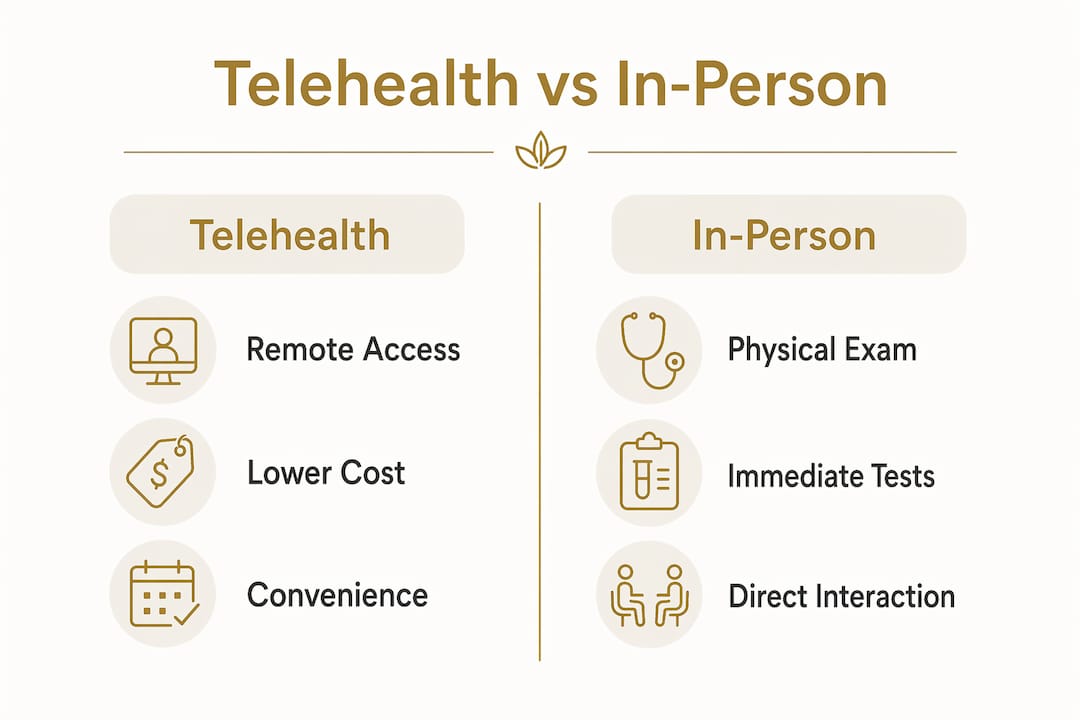
Telehealth is a delivery mechanism, not a lesser form of medicine. The American Hospital Association and Penn Medicine both distinguish it from in-person care on one core variable: whether a physical exam or point-of-care test is required. If the answer is no, telehealth is often the faster, cheaper, and equally effective option. If the answer is yes, in-person care is not optional.
In-person care gives your provider direct access to your body. They can measure your blood pressure, listen to your lungs, palpate your abdomen, draw blood, and administer vaccines. Telehealth providers work from what you tell them, what you show them, and what your home devices measure. That distinction shapes every decision about which format fits your situation.

The terminology matters here. “Telemedicine” technically refers to clinical services delivered remotely, while “telehealth” is the broader category that includes non-clinical services like patient education and administrative support. Most people use the terms interchangeably, and for practical purposes, the difference rarely affects your care decisions.
How telehealth works and when it fits your needs
Telehealth operates through two primary formats. Synchronous telehealth means real-time interaction, typically a video or phone call with a provider. Asynchronous telehealth involves sending information, photos, or symptom descriptions that a clinician reviews and responds to later. Most routine telehealth visits you will encounter are synchronous.
Common conditions and services well-suited to telehealth include:
- Medication refills and management for stable, ongoing prescriptions
- Mental health therapy and psychiatry follow-ups and new patient intakes
- Mild illness assessment such as sinus infections, UTIs, rashes, and allergies
- Chronic disease monitoring for conditions like diabetes or hypertension when labs are current
- Follow-up visits after procedures or hospital discharge
- Nutrition, lifestyle, and weight management consultations
Clinicians adapt to the absence of a physical exam by treating the telehealth session as a data-collection encounter. They ask for detailed symptom timelines, request photos of visible conditions, and incorporate readings from home devices like blood pressure cuffs or pulse oximeters. This approach compensates meaningfully for what cannot be done remotely.
The 92% of telehealth visits in 2020 conducted from home illustrates how deeply the modality has shifted care delivery toward the patient’s location rather than the clinic’s. That shift saves real time and reduces real barriers for working adults managing busy schedules.
Pro Tip: Before your telehealth visit, write down your symptoms with specific timing, take your temperature and blood pressure if you have the devices, and photograph anything visible like a rash or swelling. Providers make better decisions with better data, and you control how much you give them.
Benefits and limitations of telehealth vs traditional care
Where telehealth wins
Cost is the most documented advantage. A 2026 comparative study of over 163,000 encounters found that telemedicine episode charges averaged $96.60 versus $509.21 for in-person visits, a difference of $412.62 per episode. That is not a marginal savings. For patients paying out of pocket or managing high deductibles, that gap is significant.
Follow-up visit rates also favor telehealth. The same study found telehealth patients averaged 3.44 follow-up visits compared to 4.44 for in-person patients. Fewer follow-ups means less time off work, less transportation cost, and less disruption to daily life. The concern that telehealth would generate duplicative care has not materialized. An Epic analysis of 35 million records found no increase in in-person follow-up needs within 90 days for most telehealth visits.
Where in-person care is non-negotiable
The core limitation of telehealth is structural, not technological. Physical exam capabilities like auscultating heart sounds, palpating lymph nodes, or measuring oxygen saturation accurately cannot be replicated remotely. When your diagnosis depends on findings only a clinician’s hands and instruments can produce, telehealth creates risk rather than convenience.
| Scenario | Best format | Reason |
|---|---|---|
| Medication refill, stable condition | Telehealth | No exam needed, history sufficient |
| Mental health therapy session | Telehealth | Verbal and visual interaction adequate |
| Chest pain or shortness of breath | In-person | Requires EKG, vitals, imaging |
| Annual physical with labs | In-person | Blood draw, physical exam required |
| Rash assessment with photo | Telehealth | Visual diagnosis often sufficient |
| Vaccine administration | In-person | Physical administration required |
Technology access creates a real equity gap. Among Medicare beneficiaries aged 65 and older, 56.5% used audio-only telehealth in 2021 because they lacked video-capable devices or sufficient bandwidth. Audio-only telehealth is a legitimate and important access point, not a lesser option, for patients without smartphones or reliable internet.
Pro Tip: If you experience chest pain, sudden severe headache, difficulty breathing, signs of stroke, or high fever with stiff neck, skip telehealth entirely. These symptoms require immediate in-person or emergency evaluation. Telehealth is not designed for clinical emergencies.
When to choose telehealth and when in-person care is necessary
The decision framework is straightforward once you understand the clinical logic behind it. Ask yourself two questions: Does my situation require a physical exam or a test that needs equipment? Is this potentially an emergency? If yes to either, go in person.
Here is a practical decision guide:
- Choose telehealth for cold and flu symptoms without severe complications, UTI symptoms in otherwise healthy adults, anxiety or depression follow-ups, prescription renewals for stable conditions, skin conditions you can photograph clearly, and sleep or weight management consultations.
- Choose in-person care for annual wellness exams, vaccinations, suspected fractures or injuries, abdominal pain requiring palpation, sexually transmitted infection testing requiring swabs or blood draws, and any symptom that has worsened rapidly.
- Use a hybrid approach when your condition is chronic and requires periodic labs or physical checks but can be managed between visits via telehealth. A 2026 Veterans Health Administration study published in JAMA Network Open found that hybrid care models maintain quality outcomes better than either format used exclusively.
- Default to in-person when you are uncertain. Telehealth providers are trained to recognize when a situation exceeds what remote care can safely address and will route you appropriately. But if you have any doubt about severity, physical presence is the safer default.
The clinical reasoning behind these choices is not arbitrary. Penn Medicine’s 2026 research emphasizes that protocol-driven transitions from telehealth to in-person care, when physical findings are needed, prevent the real risk of false reassurance from a remote visit that cannot detect what it cannot see.
Cost and quality outcomes: what the evidence actually shows
The cost data on telehealth vs traditional care is now substantial enough to draw firm conclusions. Telehealth visits cost significantly less per episode, generate fewer follow-up visits, and do not increase duplicative care. For patients and payers, this is a meaningful shift in healthcare economics.
Quality outcomes tell a more nuanced story. The 2026 JAMA Network Open study from the Veterans Health Administration found that telehealth quality in primary care is comparable to in-person care when telehealth is used at moderate volumes within a hybrid model. When telehealth volume becomes very high and replaces all in-person contact, quality drops for services requiring physical presence, particularly immunizations and preventive screenings.
“Telemedicine visits cost far less than office visits and do not generate more downstream care. The data supports telehealth as a genuine replacement for many in-person visits, not just a supplement.” — Penn Medicine, 2026
The practical implication for you as a patient: telehealth is not a compromise. For the right conditions, it delivers equivalent outcomes at a fraction of the cost. The key is matching the modality to the clinical need, not defaulting to in-person care out of habit or defaulting to telehealth out of convenience.
Key takeaways
Telehealth delivers equivalent outcomes to in-person care for most non-physical-exam conditions, at significantly lower cost, making format selection a clinical decision rather than a preference.
| Point | Details |
|---|---|
| Telehealth is defined by technology, not quality | CMS defines telehealth as remote assessment, diagnosis, and consultation via telecommunications. |
| Cost advantage is documented | Telehealth episode charges average $96.60 vs $509.21 for in-person visits, per a 2026 JAMA study. |
| Physical exams require in-person care | Vital signs, imaging, vaccines, and palpation cannot be replicated remotely. |
| Hybrid models produce the best outcomes | VHA research shows combining telehealth and in-person visits maintains quality across all service types. |
| Audio-only telehealth expands access | Over half of Medicare beneficiaries aged 65+ used audio-only telehealth due to device or bandwidth limits. |
Why I think most people are asking the wrong question about telehealth
Most people frame this as “telehealth or in-person?” as if one is better than the other. After years of working in and around healthcare delivery, I think that framing misses the point entirely. The real question is: what does this specific clinical situation actually require?
I have seen patients drive 45 minutes to a clinic for a medication refill that could have been handled in a 10-minute video call. I have also seen patients use telehealth for symptoms that needed an EKG. Both are errors, and both come from treating format as a preference rather than a clinical tool.
What I find most compelling about the current evidence is that telehealth does not just save money. It does not generate more downstream visits, which was the central fear when adoption accelerated. That fear turned out to be wrong, and the data from over 35 million patient records makes that clear.
The populations I think about most are the ones who benefit from audio-only telehealth. Older adults without smartphones, rural patients without broadband, people managing multiple jobs who cannot take time off for a waiting room. For them, telehealth is not a convenience feature. It is access to care they would otherwise skip entirely.
My honest recommendation: build a relationship with a provider who uses both formats and knows when to switch. The best care is not telehealth or in-person. It is a clinician who knows which one you need today.
— Amy
How Revive-meds delivers telehealth care that actually fits your life

Revive-meds is a licensed telehealth clinic built for adults who want whole-body care without the waiting room. Backed by Revive Health Therapy, a behavioral health clinic founded in 2019, Revive-meds integrates metabolic support, GLP-1 therapy, peptides, and hormone care into a single care model. All medications are US-compounded at FDA-registered pharmacies, 99%+ purity tested, and clinician-reviewed before every order ships. If you are exploring semaglutide for weight management or want to understand your options through a telehealth visit, Revive-meds delivers care to your door in 48 to 72 hours with no membership fees and unlimited provider messaging. HSA and FSA eligible. Visit Revive-meds to get started.
FAQ
What is the main difference between telehealth and in-person care?
Telehealth delivers health services remotely via video, phone, or digital tools, while in-person care requires physical presence for exams, testing, and procedures. The deciding factor is whether your condition requires a physical exam or point-of-care test.
Is telehealth as effective as in-person care?
For conditions that do not require physical examination, telehealth produces comparable quality outcomes to in-person care at significantly lower cost, according to 2026 JAMA Network Open research.
When should you not use telehealth?
Telehealth is not appropriate for chest pain, stroke symptoms, severe abdominal pain, suspected fractures, or any condition requiring physical exam or imaging. These situations require immediate in-person or emergency evaluation.
How much does a telehealth visit cost compared to in-person?
A 2026 study of over 163,000 encounters found telehealth episode charges averaged $96.60 versus $509.21 for in-person visits, making telehealth substantially more affordable for appropriate conditions.
Can you use telehealth without a video connection?
Yes. Audio-only telehealth is a recognized and widely used format, particularly for older adults and patients without reliable internet access. Over half of Medicare beneficiaries aged 65 and older used audio-only telehealth in 2021.