

What Does Purity Tested Medication Mean?

A purity tested medication is a pharmaceutical product that has been scientifically analyzed to confirm it contains minimal impurities and meets established quality standards. The United States Pharmacopeia (USP) sets the benchmark most widely used in the US. The European Pharmacopoeia (Ph. Eur. 2.2.34) sets a comparable threshold. These thresholds exist not because perfection is achievable, but because impurities below those limits have been determined not to harm patients under normal clinical conditions.
Purity testing is not a single test. It is a systematic evaluation that checks for degradation products, residual solvents, process-related contaminants, and other unwanted components that can accumulate during manufacturing or storage. The Food and Drug Administration (FDA) requires that every approved drug meet standards for identity, strength, purity, and performance before it reaches patients.
Key features of purity tested medication:
- Defined threshold: Active pharmaceutical ingredient (API) content meeting USP standards
- Impurity profiling: Detection and quantification of degradation products, residual solvents, and process contaminants
- Regulatory backing: Compliance with FDA requirements and USP monograph specifications
- Multiple analytical methods: No single test covers all impurity types; a composite approach is standard
- Documented results: Each batch carries a Certificate of Analysis (CoA) confirming it passed testing before release
What types of impurities does purity testing detect?
Impurities in medications are unavoidable to some degree. They originate from raw materials, manufacturing processes, degradation, and residual solvents, and their presence is tightly regulated because even trace amounts can affect patient safety or reduce a drug’s effectiveness.
Process-related impurities are introduced during synthesis or purification. These include residual catalysts, reagents, and solvents used to manufacture the API. Degradation products form when a drug breaks down over time due to heat, light, moisture, or chemical reactions with excipients. Excipient impurities come from the inactive ingredients used to stabilize or deliver the drug, and they can carry their own contaminant profiles. Host cell proteins and residual DNA are additional concerns in biologics and peptide-based therapies.
The ICH (International Council for Harmonisation) guidelines define an impurity as any non-active component present in the API or finished dosage form. Limits are set based on patient safety data, not arbitrary thresholds. A contaminant that causes no measurable harm at 0.1% may be toxic at 1%.
Common impurity categories in pharmaceutical preparations:
- Residual solvents: Organic solvents used in synthesis that must be removed to safe levels
- Degradation products: Chemical breakdown byproducts from heat, light, or oxidation
- Process-related contaminants: Residual reagents, catalysts, or purification media
- Elemental impurities: Heavy metals such as lead, arsenic, or cadmium from raw material sources
- Microbiological contaminants: Bacteria, mold, or endotoxins, particularly relevant in injectable medications
- Excipient-derived impurities: Contaminants carried in by binders, fillers, or preservatives
How is medication purity tested? The main analytical methods
Purity testing in medicine relies on several analytical techniques, each designed to detect different classes of impurities. No single method catches everything, which is why quality control compiles a purity profile from multiple orthogonal approaches.
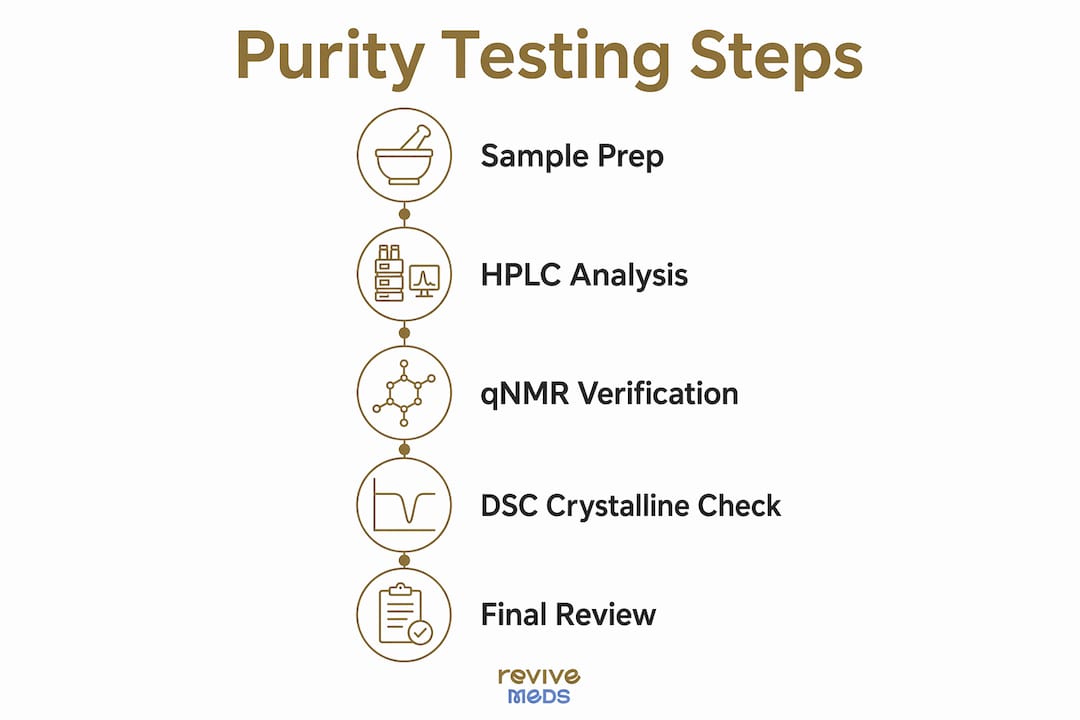
High-Performance Liquid Chromatography (HPLC) is the workhorse of pharmaceutical purity testing. It separates the API from impurities by passing the sample through a column under high pressure, then quantifies each component based on how it interacts with the column material. HPLC is particularly effective for early-phase testing and is considered sufficient for Phase 0 evaluation. Its limitation is that it can only detect compounds it is specifically calibrated to find, meaning unknown impurities may slip through.

Quantitative Nuclear Magnetic Resonance (qNMR) addresses that gap. Unlike HPLC, qNMR offers near-universal detection, meaning it can identify and quantify impurities without needing a reference standard for each one. It captures analytes that frequently escape chromatographic detection, including water and sorbents. qNMR also provides simultaneous structural and quantitative information, which makes it especially valuable for confirming both the identity and purity of a compound in a single analysis.
Differential Scanning Calorimetry (DSC) measures crystalline purity by detecting heat flow changes as a sample melts. It works well for solid-state drugs but may miss impurities that are soluble within the crystal lattice, which is why it is typically paired with chromatographic methods rather than used alone.
The pharmaceutical industry also uses a mass balance approach, which subtracts total impurities from the total sample mass to arrive at a purity figure. This approach aggregates results from multiple methods rather than relying on any single measurement.
Key purity testing techniques at a glance:
- HPLC: Separates and quantifies API and known impurities; standard for early-phase testing
- qNMR: Near-universal detection; identifies unknown impurities and confirms structure simultaneously
- DSC: Measures crystalline purity; limited for soluble impurities; best used alongside chromatography
- Mass balance: Composite calculation across methods; the most complete picture of overall purity
- Gas Chromatography (GC): Specialized for volatile residual solvents
- Inductively Coupled Plasma Mass Spectrometry (ICP-MS): Detects elemental impurities at trace levels
How purity and potency differ, and why both matter
Purity and potency are related but measure entirely different things. Confusing them is one of the most common misunderstandings in pharmaceutical quality, and the distinction has real clinical consequences.
Potency is the assay result. It tells you how much active pharmaceutical ingredient is present relative to the labeled amount. A drug with 95% potency contains 95% of the stated dose. Purity tells you how much of the total sample is the intended compound, free from impurities. A drug can be highly pure but underdosed, or correctly dosed but contaminated with degradation products.
Consider a compounded peptide that tests at 99% purity but is formulated at 80% of the labeled concentration. The purity result is excellent; the potency is not. A patient receiving that medication gets a clean product but an insufficient dose. The reverse scenario, a drug at full potency but with elevated degradation products, delivers the right dose alongside compounds that may cause adverse reactions.
Both parameters must be tested to confirm a medication is both safe and effective. Purity alone does not guarantee efficacy, and potency alone does not guarantee safety.
How purity and potency differ:
- Purity: Measures the proportion of the target compound; detects and limits harmful impurities
- Potency: Measures the amount of active ingredient relative to the labeled dose
- High purity, low potency: Clean product, insufficient therapeutic effect
- High potency, low purity: Correct dose, but potentially harmful contaminants present
- Both required: FDA and USP require testing for both in every approved drug application
Regulatory standards that govern purity testing in the United States
The FDA does not test every batch of every drug. Instead, it operates risk-based sampling programs that verify compliance with approved specifications, targeting products and manufacturers where quality concerns are most likely. The underlying standards come primarily from USP monographs.
A USP monograph is a written standard that specifies the quality expectations for a medicine, including its identity, strength, purity, and performance. It also describes the approved testing methods used to verify those criteria. When a drug has no USP monograph, the FDA tests it against the methods the manufacturer developed and submitted in the original drug application. Either way, FDA laboratories test to USP standards for identity, strength, purity, and bioavailability.
The Certificate of Analysis (CoA) is the document that captures all of this. Every batch of a pharmaceutical product must have a CoA that records purity test results and confirms the batch meets its release specifications before it is distributed. For compounded medications, understanding how US pharmacy compounding is regulated clarifies which additional oversight layers apply beyond standard FDA drug approval.
Key regulatory requirements for purity testing in the US:
- USP monograph compliance: Purity thresholds, approved test methods, and impurity limits defined per drug
- FDA approval standards: Identity, strength, purity, and potency tested per NDA, ANDA, or BLA requirements
- Risk-based sampling: FDA selects products for post-market testing based on risk signals
- Certificate of Analysis: Required for every batch; documents test results against release specifications
- ICH guidelines: International standards for impurity classification and acceptable limits
- 503B outsourcing facilities: Subject to FDA oversight and Current Good Manufacturing Practice (cGMP) requirements
Purity threshold in context: USP <891> sets a purity floor for pharmaceutical-grade substances. That figure is not a target; it is the minimum below which a substance poses unacceptable patient risk.
How purity tested medication benefits patients and clinicians
The practical value of purity testing shows up most clearly at the point of care. When a medication has been verified against established standards, patients face reduced exposure to toxic impurities that could cause adverse reactions, organ stress, or treatment failure.
For clinicians, a verified purity result changes how they can interpret a patient’s response to therapy. If a patient on a compounded GLP-1 or peptide protocol is not responding as expected, a clinician with access to CoA documentation can rule out product quality as a variable. That narrows the diagnostic field considerably. Without purity verification, an unexpected outcome could reflect the drug, the dose, the patient’s biology, or a contaminated batch. Purity testing removes one of those unknowns.

Patients receiving purity-verified medications also benefit from greater consistency between doses. Batch-to-batch variation in impurity profiles can produce inconsistent therapeutic effects even when the labeled dose stays the same. Tight purity controls reduce that variability.
Benefits of purity tested medication for patients and clinicians:
- Reduced toxicity risk: Contaminants and degradation products are controlled to safe limits
- Predictable efficacy: Consistent purity supports consistent therapeutic response
- Clinician confidence: CoA documentation allows providers to rule out product quality issues
- Regulatory assurance: Purity-tested products have passed independent verification against USP or FDA standards
- Informed prescribing: Verified purity data supports evidence-based treatment decisions
Pro Tip: When reviewing a CoA for a compounded medication, look for both the purity percentage and the specific methods used to generate it. A result from a single HPLC run is less comprehensive than one supported by qNMR or a mass balance calculation. The method matters as much as the number.
How to read purity test results and understand the limits
A purity test result is not just a number. It comes with a specification limit, a testing method, and a batch-specific context that together determine whether the result is acceptable.
The specification limit is the threshold the manufacturer and regulator have agreed the product must meet. For most small-molecule drugs, that limit aligns with USP monograph standards, which typically require purity at or above 98.5%. A result of 99.2% against a specification of ≥98.5% is a passing result with a margin of 0.7 percentage points. A result of 98.3% against the same specification is a failure, even though the absolute difference is small.
Individual impurity limits matter separately from the overall purity figure. A drug might achieve 99% total purity while still failing if a single degradation product exceeds its individual limit. ICH guidelines set specific thresholds for reporting, identifying, and qualifying individual impurities based on the daily dose and the nature of the impurity. Some impurities require toxicological evaluation before their limits can be set.
The testing method listed on the CoA tells you how the result was generated. HPLC Area% is a relative measure; it tells you the proportion of the chromatographic signal attributed to the API versus impurities. qNMR provides an absolute purity value referenced against a certified standard. These are not interchangeable, and a result generated by one method cannot be directly compared to a result from another without understanding the method’s scope and limitations.
The quality control process from raw materials to finished medication
Purity testing does not happen only at the end of manufacturing. A well-designed quality control process applies testing at every stage, from incoming raw materials through in-process checks to final product release.
Raw material testing is the first gate. Every API and excipient entering a facility must be tested for identity and purity before it is used. A contaminated raw material that passes incoming inspection will compromise every batch made from it. Manufacturers operating under cGMP are required to maintain specifications and testing records for all incoming materials.
In-process testing monitors the manufacturing steps most likely to introduce or amplify impurities. Residual solvent levels are checked after purification steps. Intermediate purity is assessed before the final formulation stage. These checkpoints catch problems before they propagate to the finished product.
Final product release testing is the last gate before distribution. The CoA generated at this stage reflects the full battery of tests, including purity, potency, identity, and dissolution where applicable. A batch that fails any specification is rejected. For 503B outsourcing facilities, which supply compounded medications to healthcare providers, FDA cGMP requirements mandate this entire process with documented traceability at each step.
Stability testing extends quality control beyond release. Manufacturers must demonstrate that a product maintains its purity and potency throughout its labeled shelf life under defined storage conditions. Degradation products that form during storage must be characterized and controlled within established limits.
Why third-party testing and certification add a layer of trust
Manufacturer testing is required, but it is also self-reported. Third-party testing provides an independent check that the same product meets the same standards when analyzed by a laboratory with no financial stake in the outcome.
Third-party laboratories, often accredited under ISO/IEC 17025, run the same analytical methods on a sample pulled from the commercial batch. Their results either confirm the manufacturer’s CoA or flag a discrepancy. When results align, the CoA carries more weight. When they diverge, the discrepancy triggers an investigation that can reveal anything from a sampling error to a systemic manufacturing problem.
For compounded medications in particular, third-party testing fills a gap. Compounded drugs are not FDA-approved products, meaning they do not go through the same pre-market review as branded or generic pharmaceuticals. Independent purity verification by an accredited lab is one of the primary ways a compounding pharmacy can demonstrate that its products meet pharmaceutical-grade standards. Revive Meds compounds all medications at FDA-registered pharmacies and requires at least 98.5% purity testing on every batch, with results documented before any product ships.
Certification programs from organizations such as NSF International and USP’s own verification program add another layer for certain product categories. These programs involve facility audits, ongoing batch testing, and the right to display a certification mark that signals independent quality verification to patients and prescribers alike.
Key Takeaways
Purity tested medication means a drug has been analytically verified to meet established thresholds, typically at or above 98.5% purity per USP standards, confirming that harmful impurities are controlled to safe limits.
| Point | Details |
|---|---|
| USP purity threshold | USP <891> requires pharmaceutical-grade substances to meet defined purity standards before patient use. |
| Multiple methods required | No single test detects all impurities; HPLC, qNMR, and DSC each cover different impurity types. |
| Purity vs. potency | Purity confirms absence of contaminants; potency confirms correct dosage. Both must be tested. |
| CoA documentation | Every batch must carry a Certificate of Analysis recording test results against release specifications. |
| Third-party verification | Independent lab testing confirms manufacturer results and is especially critical for compounded medications. |
Revive Meds: purity you can verify, not just trust
Every medication Revive Meds dispenses is compounded at an FDA-registered pharmacy and 99%+ purity tested before it ships. That is not a marketing claim; it is a documented standard backed by CoA records generated through the same analytical methods described throughout this article. Whether you are starting a clinician-supervised GLP-1 protocol or exploring peptide therapy, you get a product that has been verified, not assumed, to meet pharmaceutical-grade purity standards.
No membership fees. No waiting rooms. Same-day onboarding with a licensed clinician who reviews your full medical intake before anything is prescribed. Real medicine, real oversight.