
How Telehealth Prescriptions Are Delivered to Your Door

Telehealth prescriptions are delivered through a coordinated chain of electronic prescribing, pharmacy verification, and direct-to-home shipping that begins the moment a licensed provider ends your virtual consultation. The process relies on ePrescribing networks like Surescripts to route your prescription securely to a state-licensed pharmacy, where pharmacists verify credentials, check insurance, and prepare your medication before a carrier delivers it to your address. Understanding how telehealth prescriptions are delivered matters because the timeline, your state’s regulations, and the type of medication you need all shape what happens between your appointment and your front door.
How are telehealth prescriptions sent after your virtual visit?
The telehealth prescription process starts with your provider’s license, not their platform. Under federal and state law, the prescriber must hold an active license in the state where you are physically located during the consultation. This state-specific licensing requirement is the first compliance checkpoint in the entire chain.
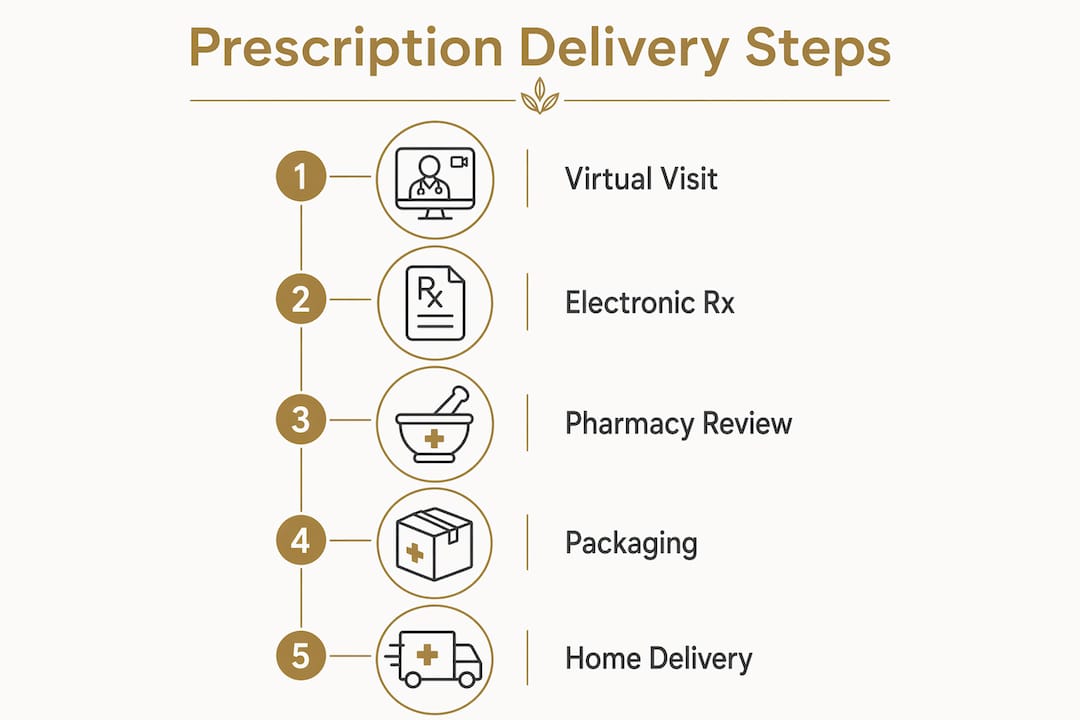
Once that box is checked, here is what happens in sequence:
- Provider creates the electronic prescription. Your clinician enters your medication, dosage, and instructions into their electronic health record system. The prescription becomes a structured digital data object, not a scanned document or PDF.
- ePrescribing network routes the order. The prescription travels through a third-party network that handles routing, validation, and compliance before the pharmacy ever sees it. Surescripts processes the majority of electronic prescriptions in the United States.
- Pharmacy receives and queues the order. The prescription lands in the pharmacy’s workflow system, where it joins a queue for human review.
- Multi-layer verification begins. Pharmacists check provider credentials, confirm patient identity, review the medication for appropriateness, and run insurance or payment verification. Pharmacy verification is not a formality. It is a legal requirement before any medication is dispensed.
- Controlled substances follow a separate path. Schedule II through V medications require additional DEA compliance steps. The DEA has extended flexibility allowing practitioners to prescribe controlled substances via telehealth without an in-person visit through December 31, 2026, but pharmacies still apply stricter verification protocols for these drugs.
- Medication is prepared and labeled. For compounded medications, this step includes formulation and purity testing. For standard medications, it means counting, packaging, and labeling.
- Order is handed to shipping. The pharmacy generates a tracking number and transfers the package to a carrier.
Pro Tip: Before your telehealth appointment, confirm that your provider is licensed in your current state of residence. If you recently moved or are traveling, a prescription issued to the wrong state can delay your medication by days.
What to expect when delivering telehealth medications to your home

Once the pharmacy releases your order, the physical delivery phase begins. Shipping timelines range from same-day courier service in select metro areas to two to five business days for standard mail, depending on the carrier and the medication type.
Here is what the delivery phase actually looks like:
- Standard shipping via USPS, FedEx, or UPS covers most non-urgent, non-temperature-sensitive medications. Expect two to five business days from the time the pharmacy ships.
- Expedited or overnight shipping is available through most telehealth pharmacy partners for an added fee. Clinics like Revive-meds typically deliver within 48 to 72 hours of clinician approval.
- Cold-chain logistics apply to biologics, peptides, and certain GLP-1 medications. Temperature-sensitive medications require insulated packaging with gel packs or dry ice to maintain integrity during transit. This is non-negotiable for medications like semaglutide.
- Tracking is standard. You will receive a tracking number by email or through your telehealth platform’s portal once the pharmacy ships. Check both sources, since platform updates sometimes lag behind carrier scans.
- Package labeling is typically discreet. The outer box usually shows the pharmacy’s name or a neutral return address. However, return address details can vary by pharmacy, and some labels do display the pharmacy’s full name.
Pro Tip: If privacy matters to you, ask your telehealth provider or pharmacy specifically what appears on the return label before your order ships. Most pharmacies will accommodate a request for neutral labeling.
What legal rules affect telehealth prescription delivery in 2026?
Federal and state regulations govern both what can be prescribed remotely and how those prescriptions are delivered. The two layers do not always align, which creates real-world friction for patients.
| Regulation type | What it covers | 2026 status |
|---|---|---|
| DEA controlled substance rule | Allows Schedule II-V prescribing via telehealth without in-person visit | Extended through Dec 31, 2026 |
| State prescriber licensing | Prescriber must be licensed in the patient’s physical location state | Strictly enforced in all 50 states |
| State controlled substance laws | Some states impose stricter rules than federal minimums | Varies widely by state |
| Pharmacy delivery licensing | Mail-order pharmacies must be licensed in the destination state | Required for legal delivery |
| Compounded medication rules | FDA-registered compounding pharmacies required for telehealth compounds | Applies to GLP-1s, peptides, hormones |
State laws often impose stricter requirements than federal regulations for controlled substances, which means a prescription that is federally legal can still be blocked at the state level. This is the single most common reason patients experience unexpected delays or denials when using telehealth for the first time.
The pharmacy you use must also hold an active license in your state. A telehealth clinic based in Texas cannot legally ship a controlled substance to a patient in New York unless the fulfilling pharmacy is licensed in New York. This is why reputable telehealth services work with networks of pharmacies licensed across multiple states rather than a single facility.
How does technology protect your prescription from provider to pharmacy?
Electronic prescriptions are not static documents. They are dynamic data objects that carry real-time validation flags, audit trails, and structured fields that reduce transcription errors. This is a fundamental difference from paper prescriptions, where a pharmacist had to interpret handwriting and manually re-enter data.
ePrescribing networks use interoperability standards including HL7 and FHIR to allow secure data exchange between provider systems, routing networks, and pharmacy management platforms. Every transaction is logged with timestamps and user identifiers, creating a complete audit trail that regulators, insurers, and pharmacists can access if a question arises.
Multi-factor authentication protects the prescribing end. A provider cannot issue a controlled substance prescription without verified credentials tied to their DEA registration. At the pharmacy end, the system flags drug interactions, dosage anomalies, and duplicate prescriptions automatically before a human pharmacist ever reviews the order.
“Electronic prescriptions serve as dynamic, real-time data with audit trails that enhance medication safety beyond traditional paper prescriptions.” — The ePrescribing Ecosystem
That said, technology does not replace human judgment. Pharmacists remain the final checkpoint. Automated flags can miss context that a trained pharmacist catches, which is why the human review step at the pharmacy is legally required and practically irreplaceable.
How to track and manage your telehealth prescription receipt
Knowing the terminology your telehealth platform uses is the fastest way to avoid confusion about where your medication actually is.
- “Sent” means your provider transmitted the prescription to the pharmacy. It does not mean the pharmacy has processed it. The “sent” notification triggers internal pharmacy workflows including insurance checks, stock availability, and compliance review. None of that is visible to you.
- “Received” means the pharmacy has the prescription in its system and has begun review.
- “Filled” means the medication is prepared and ready for shipment or pickup.
- “Shipped” means a carrier has the package and a tracking number exists.
To stay on top of your order, log into both your telehealth platform and your pharmacy’s patient portal. The two systems update independently, and one often has more current information than the other. If your status has not moved from “received” to “filled” within 48 hours of a non-controlled prescription, contact the pharmacy directly. Ask specifically whether there is an insurance hold, a stock issue, or a pharmacist question pending.
For privacy, you can request discreet packaging details before your order ships. Most telehealth-affiliated pharmacies will tell you exactly what the outer label looks like. If you are receiving a medication that requires a signature on delivery, arrange to be home or authorize a neighbor in advance. Missed deliveries for temperature-sensitive medications can compromise the product entirely.
You can also learn how to message your telehealth provider through your platform’s portal to ask about prescription status without scheduling a new appointment.
Key takeaways
Telehealth prescriptions move through a legally regulated, technology-supported chain from provider to pharmacy to your door, and knowing each step prevents delays and protects your privacy.
| Point | Details |
|---|---|
| Prescriber licensing is step one | Your provider must be licensed in the state where you are physically located during the visit. |
| ePrescribing networks route securely | Networks like Surescripts handle validation and compliance before the pharmacy receives your order. |
| “Sent” does not mean “shipped” | Pharmacy processing includes insurance, stock, and compliance checks that take additional time. |
| Cold-chain matters for some medications | Peptides, GLP-1s, and biologics require temperature-controlled packaging to arrive safely. |
| State law can be stricter than federal | Some states impose requirements beyond DEA rules, affecting which medications can be delivered remotely. |
What I’ve learned about telehealth prescription delivery that most articles skip
Most explainers on this topic treat the process as a straight line: appointment, prescription, delivery. The reality is more like a relay race with handoffs that can stall at any baton pass.
The handoff I see trip people up most often is the gap between “sent” and “filled.” Patients assume that once their provider clicks send, the pharmacy is already packing the box. In practice, the pharmacy may sit on a prescription for 24 to 48 hours while it resolves an insurance question or waits for a pharmacist to complete the review queue. If you do not check your pharmacy portal independently, you will not know this is happening.
The second thing most articles skip is the state licensing layer. I have seen patients book appointments with telehealth providers they found through an ad, complete a full consultation, and then discover the provider is not licensed in their state. The prescription is legally unenforceable. The fix is simple: confirm licensing before you book, not after. Revive-meds lists its licensed states clearly, which is the standard every telehealth clinic should meet.
The emerging trend worth watching is real-time pharmacy integration. Some telehealth platforms are beginning to connect directly with pharmacy management systems so that prescription status updates appear inside the telehealth app rather than requiring a separate pharmacy portal login. When that becomes standard, the patient experience will improve significantly. Until then, checking both systems is the practical move.
— Amy
How Revive-meds handles your prescription from approval to delivery
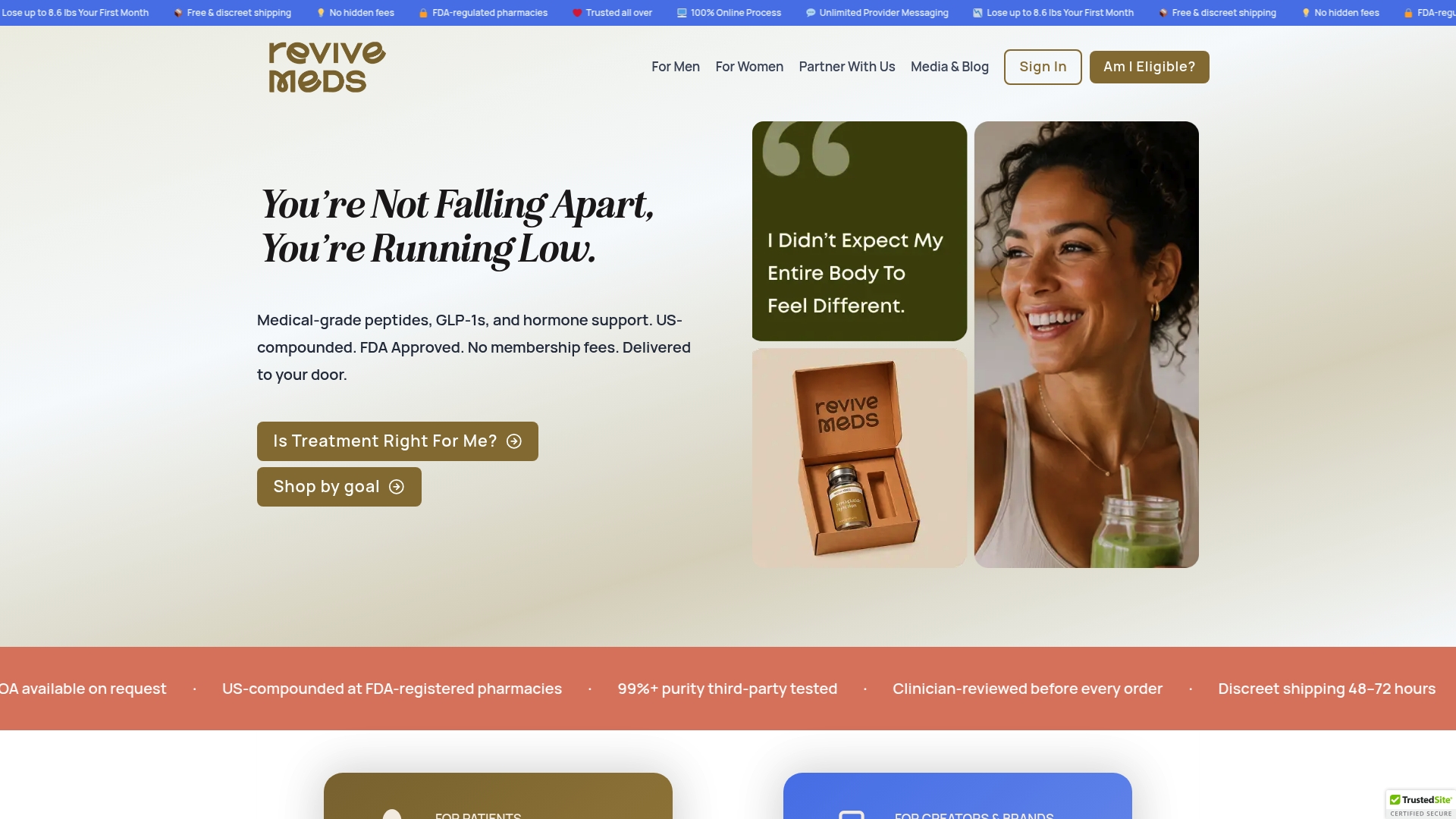
Revive-meds operates as a licensed telehealth clinic backed by Revive Health Therapy, a behavioral health practice founded in 2019. Every prescription, including semaglutide and peptide therapies, is clinician-reviewed before it ships from an FDA-registered, US-based compounding pharmacy with 99%+ purity testing. There are no membership fees and no waiting rooms. Once your clinician approves your order, medications arrive discreetly at your door within 48 to 72 hours. HSA and FSA payments are accepted. If you want to understand what GLP-1 medications actually do at the receptor level before starting, the GLP-1 receptor explainer is a good place to start.
FAQ
How long does telehealth prescription delivery take?
Most telehealth prescriptions ship within one to two business days of pharmacy approval, with delivery taking two to five additional days via standard carriers. Clinics like Revive-meds that use expedited shipping typically deliver within 48 to 72 hours of clinician sign-off.
Can telehealth providers prescribe controlled substances without an in-person visit?
Yes, through December 31, 2026, DEA-registered practitioners can prescribe Schedule II-V substances via telehealth without a prior in-person evaluation, provided all legal criteria are met. State laws may impose additional restrictions beyond this federal flexibility.
What does “prescription sent” mean in a telehealth portal?
“Sent” means your provider transmitted the prescription to the pharmacy. It does not mean the medication is ready or shipped. The pharmacy still needs to complete insurance verification, stock checks, and pharmacist review before dispensing.
Are telehealth prescription packages discreet?
Outer packaging is generally plain, but the pharmacy’s name or address may appear on the return label. You can request discreet packaging details from your pharmacy before your order ships to confirm exactly what will appear on the box.
Do all states allow the same telehealth prescriptions?
No. The prescriber must be licensed in your current state, and state laws on controlled substances vary significantly. Some states require in-person evaluations for specific drug categories regardless of federal DEA rules.