

Why Subscription Clinics Differ from Telehealth Models

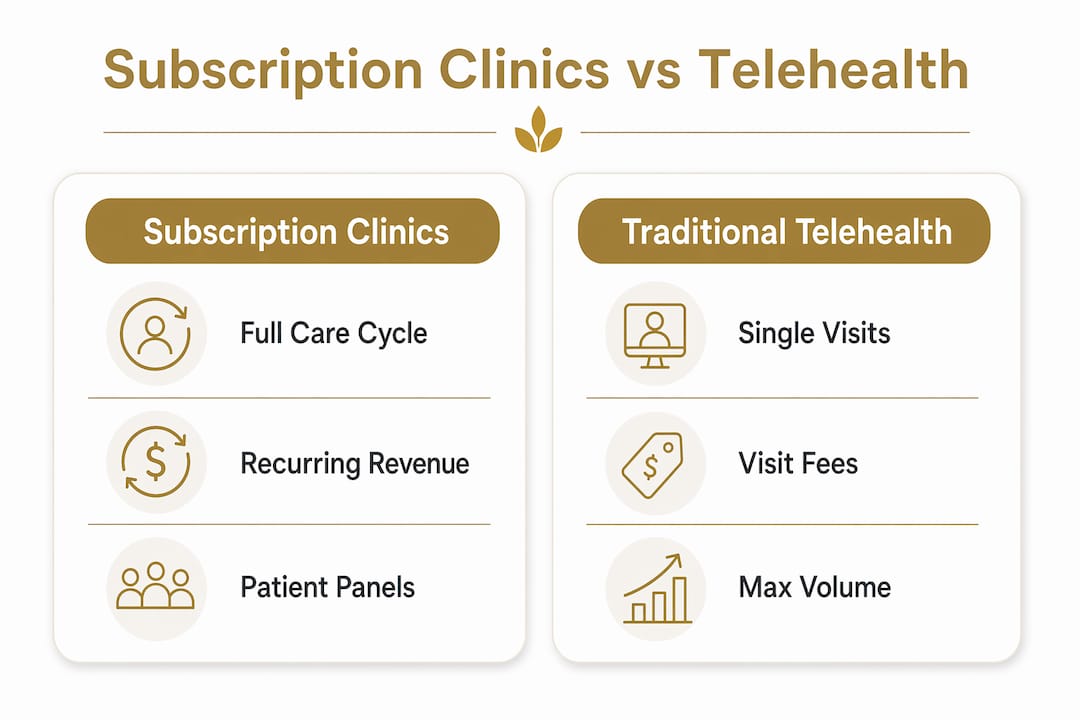
Subscription clinics are defined as care models that combine full clinical workflows, recurring patient relationships, and integrated management tools under a single ongoing fee structure. This is fundamentally different from traditional telehealth platforms, which function primarily as communication layers connecting patients to providers for one-time or episodic visits. Understanding why subscription clinics differ from telehealth matters because the two models produce different outcomes, different economics, and a completely different patient experience. The subscription telehealth segment is growing at a 28 to 35% CAGR, roughly three times faster than per-visit telehealth. That growth signals a structural shift in how patients and providers think about care delivery.
Why subscription clinics differ from telehealth in operations and workflow
The most concrete distinction between subscription clinics and traditional telehealth platforms is the scope of what each model actually does. Traditional telehealth platforms, including many widely used video visit services, are built to facilitate communication. They connect a patient to a provider, support a video or messaging session, and close the encounter. The workflow begins and ends there.
Subscription clinics operate on a fundamentally different architecture. Digital clinics orchestrate care across the full patient journey, from intake and clinical protocol design through lab ordering, prescription management, and structured follow-up. The platform is not just a communication tool. It is a care delivery system.

This distinction has real consequences for patients. When a telehealth platform ends a video visit, the patient is responsible for coordinating next steps, whether that means ordering labs, finding a pharmacy, or scheduling a follow-up. In a subscription clinic, those steps are embedded in the workflow. The care does not stop when the screen goes dark.
The operational differences also affect providers. Subscription clinics use care routing to automate routine interactions and escalate complex cases to clinicians, which is a design philosophy that has nothing in common with a remote call center model. Providers in subscription clinics spend their time on clinical decisions, not administrative coordination.
- Intake and onboarding are protocol-driven, not ad hoc
- Lab ordering and results review are built into the care cycle
- E-prescribing connects directly to compounding or retail pharmacies
- Follow-up is scheduled and automated, not patient-initiated
- Asynchronous messaging handles routine questions without consuming appointment slots
Pro Tip: When evaluating any telehealth service, ask whether follow-up, labs, and prescription management are included in the platform or whether you are expected to coordinate those steps independently. The answer tells you whether you are looking at a communication tool or a care delivery system.
How the economic models compare between subscription clinics and telehealth
The financial structure of a subscription clinic and a traditional telehealth platform are not just different in degree. They are different in kind. Traditional telehealth platforms generate revenue per visit, typically between $50 and $150 per encounter. The incentive is volume. More visits mean more revenue, regardless of whether any individual patient improves.
Subscription clinics generate patient lifetime value of $3,000 to $12,000 annually, with margins in the 65 to 80% range when workflows are properly designed. That revenue structure changes what providers are incentivized to do. A subscription clinic earns more when patients stay enrolled, which means it earns more when patients get better and remain engaged. The financial model and the clinical goal are aligned.
The cash-pay basis common to subscription clinics also removes a significant cost layer. Insurance billing adds 15 to 30% overhead and delays claim adjudication by 30 to 45 days. Subscription clinics operating outside insurance networks eliminate that friction entirely, which means providers spend more time on care and less time on billing disputes.
| Feature | Subscription clinic | Traditional telehealth |
|---|---|---|
| Revenue model | Recurring monthly or annual fee | Per-visit transaction |
| Patient lifetime value | $3,000 to $12,000+ annually | $50 to $150 per visit |
| Insurance dependency | Typically cash-pay | Often insurance-billed |
| Provider incentive | Long-term patient outcomes | Visit volume |
| Administrative overhead | Reduced by 40 to 60% | High, due to billing complexity |
Pro Tip: HSA and FSA accounts are often eligible for subscription clinic fees. If you are comparing costs, factor in the tax advantage of paying with pre-tax dollars, which can reduce your effective out-of-pocket cost by 20 to 37% depending on your tax bracket.
The shift from visit volume to patient lifetime value is not just a business model change. It is a realignment of clinical incentives that has downstream effects on the quality and consistency of care patients receive.
What the patient experience looks like in each model
From a patient perspective, the differences in healthcare delivery between subscription clinics and traditional telehealth show up most clearly in three areas: continuity, access, and communication.
Traditional telehealth delivers convenience. You can see a provider quickly, often within hours, without traveling to a clinic. That is genuinely valuable for acute, one-time needs. However, the provider you see today is rarely the same provider you will see next month. There is no longitudinal relationship, no shared history, and no coordinated plan. Each visit starts from scratch.
Subscription clinics are built around the opposite model. Patients in subscription models expect controlled panel sizes, longer visits, and stronger responsiveness from their care team. The relationship is the product. Providers in subscription clinics know their patients’ histories, track progress over time, and adjust protocols based on what is actually working.
The practical differences for patients include:
- A consistent provider or care team rather than rotating clinicians
- Asynchronous messaging available between appointments for questions and updates
- Proactive follow-up built into the care cycle, not dependent on patient initiative
- Preventive and monitoring care included, not billed separately
- Defined response time expectations that are part of the service agreement
Access responsiveness is a defining feature of the subscription model. Panel size management is how subscription clinics protect that responsiveness. By limiting the number of patients per provider, clinics maintain the availability that makes ongoing relationships functional. Traditional telehealth platforms have no such constraint because each visit is independent.
For patients managing chronic conditions, metabolic health goals, or ongoing hormone or peptide therapy, the subscription model delivers something telehealth platforms structurally cannot: a care relationship that compounds over time.
How technology enables the subscription clinic model
Technology is what makes the subscription clinic model scalable without sacrificing care quality. The difference between a subscription clinic and a traditional telehealth platform is not just clinical philosophy. It is software architecture.
Subscription clinic technology integrations include asynchronous messaging, lab ordering, e-prescribing, care plan management, and follow-up automation. Telehealth platforms are primarily built for real-time communication: video calls and synchronous chat. That is a narrower technical scope, and it produces a narrower care scope.
| Technology capability | Subscription clinic | Traditional telehealth |
|---|---|---|
| Asynchronous messaging | Core feature | Limited or absent |
| Lab ordering and review | Integrated | Typically external |
| E-prescribing | Built-in workflow | Often manual or separate |
| Care plan management | Ongoing and structured | Per-visit only |
| Follow-up automation | Systematic | Patient-initiated |
The deeper insight is that workflow innovation drives margin and scalability in subscription clinics, not simply adding more clinicians. A well-designed subscription clinic routes asynchronous questions to care coordinators, flags lab results for clinical review, and escalates urgent cases automatically. This triage logic is what allows a small clinical team to manage a large panel without compromising care quality.
Traditional telehealth platforms are not designed for this. They are built to maximize the number of synchronous encounters, which is a fundamentally different optimization target. You can learn more about telehealth vs in-person care to understand where each model fits in a broader care strategy.
Key takeaways
Subscription clinics and traditional telehealth platforms are structurally different models, and conflating them leads to mismatched expectations about what care you will actually receive.
| Point | Details |
|---|---|
| Workflow scope | Subscription clinics manage the full care cycle; telehealth platforms manage communication only. |
| Economic incentives | Subscription revenue aligns provider incentives with patient outcomes, not visit volume. |
| Patient continuity | Subscription models deliver longitudinal relationships; telehealth delivers episodic convenience. |
| Technology design | Subscription clinics integrate labs, e-prescribing, and automation; telehealth focuses on real-time video. |
| Administrative efficiency | Cash-pay subscription models reduce billing overhead by 40 to 60% compared to insurance-based telehealth. |
The model that actually matches how health works
I have spent years watching patients cycle through telehealth platforms and come away frustrated, not because the providers were bad, but because the model was wrong for what they needed. A video visit for a one-time sinus infection is perfectly suited to telehealth. A patient managing metabolic dysfunction, hormone imbalance, or a GLP-1 protocol needs something the per-visit model cannot provide: a care relationship that builds on itself.
The mistake most people make is assuming that telehealth and subscription clinics are the same thing delivered at different price points. They are not. They are different products built on different assumptions about what healthcare is. Telehealth assumes care is episodic. Subscription clinics assume care is continuous. Both assumptions are correct for different situations, which is exactly why conflating the two leads to poor decisions.
What I find most underappreciated is the economic alignment argument. When a clinic earns more by keeping you enrolled and healthy, it has a financial reason to invest in your outcomes. That is not idealism. It is incentive design. Per-visit telehealth has no such alignment. The platform earns the same whether you improve or not.
The subscription model is not perfect. Panel size management is genuinely hard. Setting patient expectations around response times and included services requires discipline. Clinics that grow too fast without managing their patient load lose the responsiveness that makes the model valuable. But these are execution problems, not structural flaws. The model itself is the right architecture for ongoing, relationship-driven care.
If you are evaluating no-membership telehealth options alongside subscription clinics, the honest question to ask is what kind of care you actually need. For acute, one-off needs, transactional telehealth is efficient and appropriate. For anything that requires monitoring, adjustment, and continuity, the subscription model is not just better. It is the only model built to deliver what you need.
— Amy
How Revive-meds delivers integrated care beyond a single visit
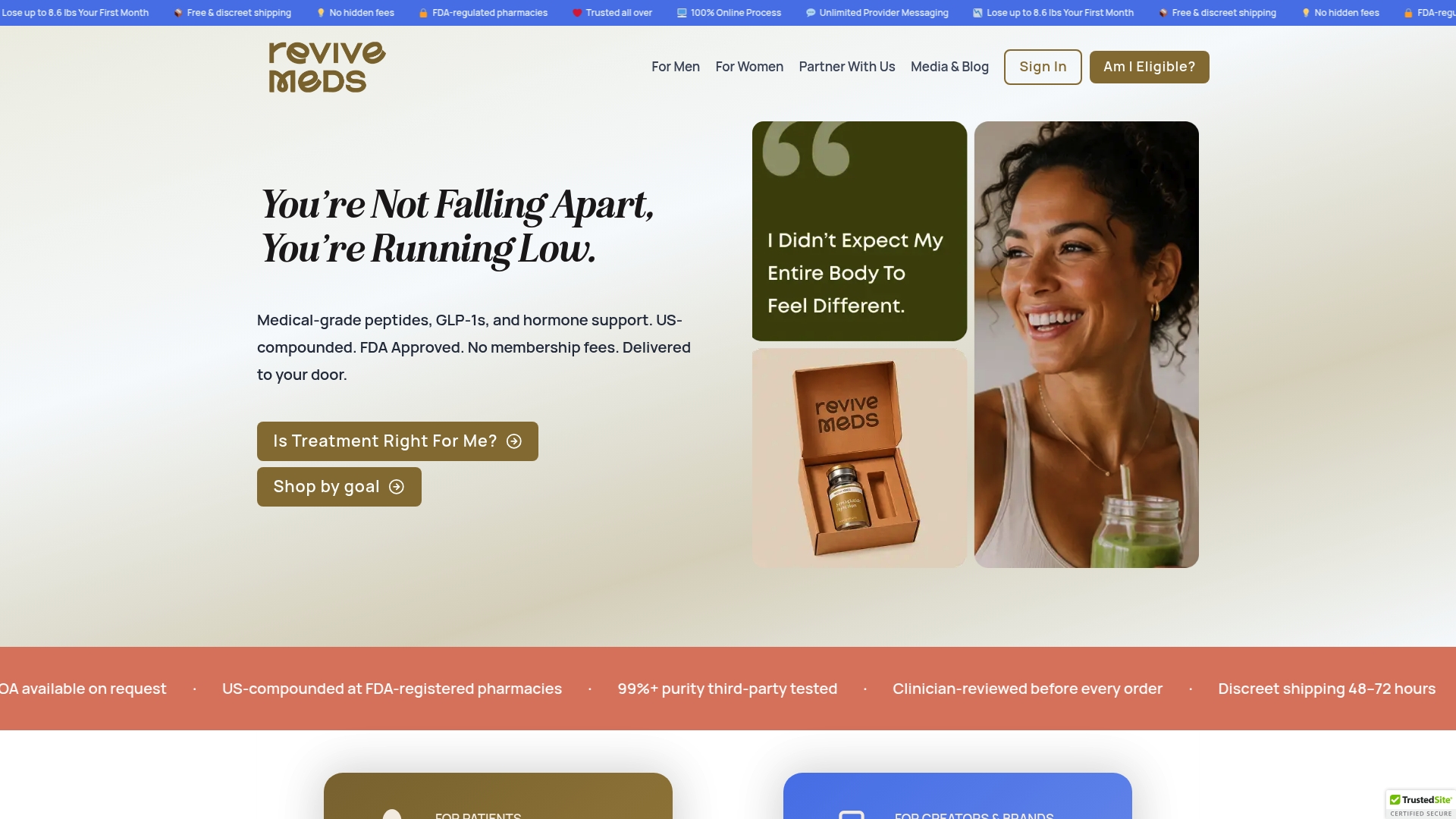
Revive-meds is built on the subscription clinic model described throughout this article, with one meaningful addition: it is the first mental health clinic to formally integrate metabolic and peptide therapy into a whole-person care protocol. There are no membership fees and no waiting rooms. Every order is clinician-reviewed, compounded at FDA-registered pharmacies with 99%+ purity testing, and delivered to your door in 48 to 72 hours. Unlimited provider messaging is included, and all plans are HSA/FSA eligible. If you are exploring GLP-1 therapy as part of an ongoing care plan, the GLP-1 receptor guide explains exactly how these therapies work at the clinical level. For patients ready to understand the full protocol, GLP-1 Squared covers the integrated treatment approach in detail.
FAQ
What makes a subscription clinic different from telehealth?
A subscription clinic manages the full care cycle, including intake, labs, prescriptions, and follow-up, under a recurring fee model. Traditional telehealth platforms primarily provide video or messaging visits without integrated workflow management.
Are subscription clinics more expensive than telehealth?
The per-month cost of a subscription clinic is typically higher than a single telehealth visit, but the annual value is greater because labs, follow-up, and ongoing management are included. HSA and FSA eligibility also reduces the effective out-of-pocket cost for many patients.
Do subscription clinics take insurance?
Most subscription clinics operate on a cash-pay basis, which eliminates insurance billing overhead and allows providers to focus on clinical care rather than claims management. This structure reduces administrative costs by 40 to 60% compared to insurance-based models.
Why is care continuity better in a subscription model?
Subscription clinics control panel size to maintain provider availability and build longitudinal patient relationships. Traditional telehealth platforms rotate providers across encounters, which means each visit starts without shared history or a coordinated care plan.
Is telehealth ever the better choice?
Telehealth is the right choice for acute, one-time needs where a single encounter resolves the issue. For ongoing conditions, metabolic goals, or therapies that require monitoring and adjustment, the subscription clinic model is structurally better suited to deliver consistent outcomes.